

Most borrowers in 2026 will lose over $2,450 to “ghost fees” and unoptimized interest rates simply because they trust the first number a big bank shows them. It’s exhausting to hunt for a personal loan calculator monthly payment that actually accounts for the 0.5% fluctuations in today’s volatile market. You likely feel the weight of 2026 interest rates and the nagging anxiety of hidden origination fees buried in the fine print.
We believe you shouldn’t have to be a math genius to outsmart traditional lenders. If you’re looking to gain total control over your financial future, this guide will teach you how to manipulate loan variables to save thousands in interest. We’ll strip away the intimidation factor and show you exactly how to secure the lowest total cost of borrowing. This article provides a clear, data driven roadmap to help you lock in a predictable budget and beat the banks at their own game.
Key Takeaways
- Learn why a low payment often hides high total costs and how to balance principal, interest, and time for maximum savings.
- Use a personal loan calculator monthly payment to master the “Term Shortener” strategy and slash your total interest by up to 30%.
- Identify and neutralize hidden fee traps, including origination fees and prepayment penalties that can drain your bank account.
- Assemble your professional “Hunter’s Kit” to streamline the application process and secure funding with the confidence of a market expert.
- Discover how to leverage the “Soft Pull” advantage to shop and compare multiple lenders without leaving a single dent in your credit score.
Beyond the Number: Why Your Monthly Payment is Only Half the Story
Your monthly payment feels like the final boss of financial planning. It isn’t. When you use a personal loan calculator monthly payment tool, you see a single, digestible figure. This number represents the intersection of your principal, your interest rate, and your repayment term. It tells you if you can afford the loan today, but it stays silent about whether the loan is actually a good deal. A low monthly payment often acts as a mask for a high-cost debt trap that drains your wealth over years.
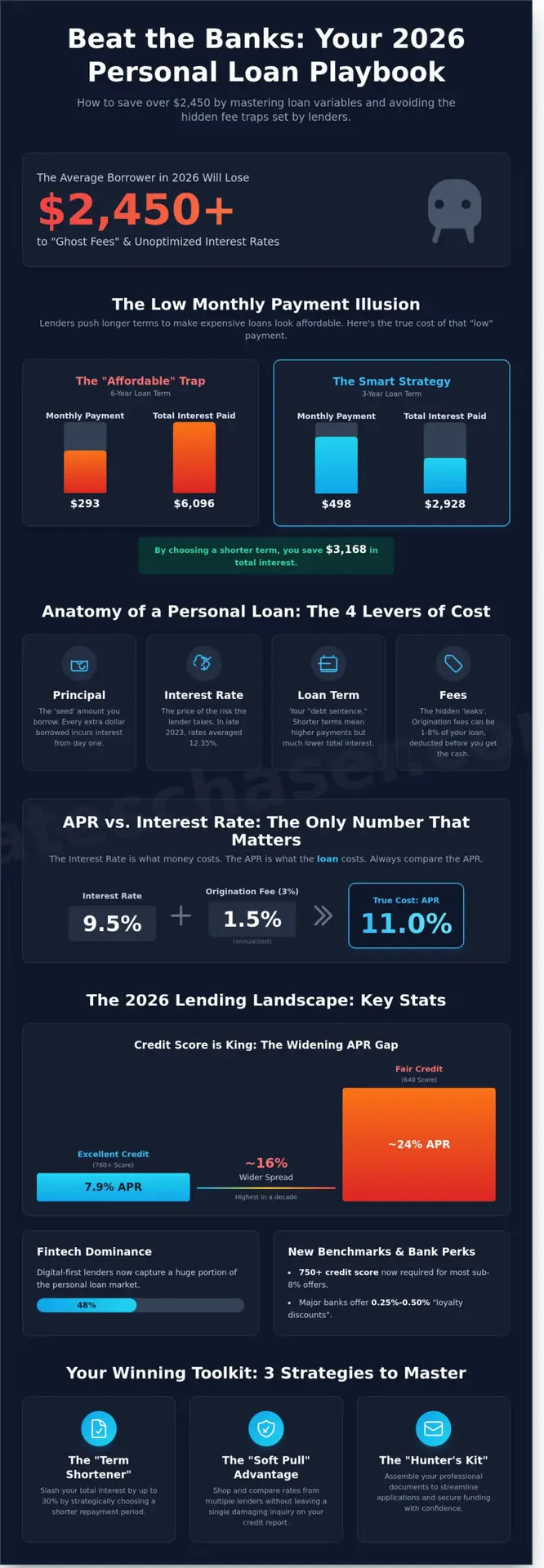
To master your finances, you must look at The Anatomy of a Personal Loan. This involves separating the amount you borrow from the premium you pay for the privilege of immediate cash. In the 2026 lending market, banks have pivoted. They know that 64% of consumers prioritize monthly cash flow over total interest paid. Consequently, lenders now push longer repayment terms to make expensive loans look “affordable.” If you stretch a $15,000 loan from three years to six, your payment drops significantly, but your total interest cost can easily double. You aren’t saving money; you’re just paying more slowly.
The psychological trap of the “affordable” payment is dangerous. It encourages you to focus on whether you can fit the bill into your current lifestyle rather than the long-term impact on your net worth. Avoid this by always checking the total interest paid over the life of the loan. If the convenience of a lower payment costs you an extra $3,000 in interest, ask yourself if that flexibility is truly worth the price. Smart borrowers chase the lowest total cost, not just the easiest monthly check.
The Difference Between Interest Rate and APR
The interest rate is the basic percentage the lender charges on your principal balance. It’s a raw number that ignores the “hidden” costs of doing business. APR, or Annual Percentage Rate, is the all-in cost that includes the interest rate plus origination fees, processing charges, and any mandatory insurance. While the interest rate tells you what the money costs, the APR tells you what the loan costs. The APR is the only number that matters for a true comparison because it levels the playing field between lenders with different fee structures.
Why 2026 Rates are Different
The 2026 lending climate has shifted away from the volatility seen in the early 2020s. As of January 2026, the benchmark for “Excellent” credit has tightened. While a 720 score used to secure the best rates, most top-tier lenders now demand a 750 or higher to unlock sub-8% offers. Digital-first lenders have also matured, now capturing 48% of the personal loan market. These fintech firms use alternative data, like your utility payment history, to price risk more aggressively than traditional banks.
Traditional banks have responded by focusing on relationship-based pricing. If you’ve held a checking account with a major bank for more than 24 months, you might find “loyalty discounts” of 0.25% to 0.50% off your quoted rate. Using a personal loan calculator monthly payment feature allows you to see how these small basis point shifts affect your bottom line. In 2026, the gap between “Fair” and “Excellent” credit tiers has widened; a borrower with a 640 score might face APRs near 24%, while a 760 score secures 7.9%. This 16% spread is the highest seen in the last decade, making your credit health more valuable than ever.
The Anatomy of a Personal Loan: Four Variables That Dictate Your Cost
Understanding the math behind your debt transforms you from a passive borrower into a strategic hunter. Your personal loan calculator monthly payment isn’t a random figure generated by a bank; it’s the precise output of four distinct variables. To secure the best deal, you must manipulate these levers to your advantage. If you don’t master these components, you’re essentially handing the lender a blank check.
- Principal: This is the “seed” amount you’re borrowing. It’s the raw capital you receive. While it’s tempting to round up, every extra dollar borrowed incurs interest from day one.
- Interest Rate: This represents the price of the risk the lender takes on you. Data from the Federal Reserve shows historical personal loan rates have fluctuated significantly; for instance, 24-month personal loan rates averaged 12.35% in late 2023.
- Loan Term: This is your “debt sentence.” It’s the duration you’ve agreed to carry the balance. Shorter terms mean higher monthly costs but lower total interest.
- Fees: These are the hidden “leaks” in your agreement. Origination fees often range from 1% to 8% of the total loan. A calculator must account for these, as they’re often deducted from your principal before you even see the cash.
How Principal Amounts Affect Your Rate Tiers
Lenders categorize risk using specific loan size “sweet spots.” Borrowing $9,500 might actually cost you more than borrowing $10,500. Banks often drop interest rates when you cross into a higher tier, such as the $10,000 or $25,000 threshold. They want to move larger volumes of capital and will reward you with a 0.5% to 1.5% rate reduction for hitting those marks. However, don’t over-borrow just because the personal loan calculator monthly payment looks affordable. Taking on $5,000 in unnecessary debt to save 1% on interest is a losing strategy that inflates your total repayment.
The Term Length Trade-Off
Choosing your term length is a balancing act between monthly breathing room and long-term wealth. A 36-month term is the gold standard for efficiency, but 72-month or 84-month terms are becoming more common. You must visualize the “Interest Cliff.” On a $20,000 loan at 10%, extending your term from 36 to 60 months drops your payment by roughly $230. It also adds over $2,100 in total interest costs. You’re paying a massive premium for that monthly flexibility.
If you’re using a loan for debt consolidation, calculate your “break-even” point. If your new loan doesn’t clear your existing high-interest credit card debt within 24 to 48 months, you might just be shifting the problem rather than solving it. You should compare personal loan offers to see which lenders offer the most aggressive terms for your specific credit profile. Use the data to outsmart the banks and minimize your total interest outflow. Every month you shave off your term is a direct win for your net worth.
The RatesChaser Strategy: How to Manipulate Loan Terms to Save Thousands
Stop viewing your personal loan as a fixed cost. It is a variable equation you can control. Rate hunting is the strategic process of using a personal loan calculator monthly payment tool to identify where lenders are overcharging and where they are desperate for your business. You aren’t just a borrower. You are a strategist looking for a competitive edge in a crowded financial market.
The first maneuver in your arsenal is the Term Shortener. Most borrowers choose the longest term possible to keep their immediate costs low. This is a mistake that costs thousands. If you increase your calculated monthly payment by just 10% above the lender’s minimum requirement, you can often slash your total interest obligation by 30%. For a $15,000 loan at 12% interest over five years, adding $35 to your payment kills the debt 14 months early. It turns a standard loan into a high-speed repayment vehicle.
The second maneuver is the Fee Offset. Lenders frequently hide high origination fees, sometimes reaching 8% of the total loan, behind a lower advertised interest rate. You must use your data to compare a 10% rate with a 5% fee against an 11% rate with zero fees. Over a 36-month term, the higher rate with no fees is almost always the cheaper option. Understanding how to calculate loan payments allows you to see the true cost of every dollar borrowed before you ever sign a contract.
Benchmarking your offers against real-time market data is the final step. Rates change daily based on Federal Reserve signals and institutional liquidity. If the personal loan calculator monthly payment you see online doesn’t match the quote from your bank, the bank is likely padding their margin. Demand a match or move your business to a digital disruptor that values transparency.
Reverse-Engineering Lender Offers
Don’t take a pre-qualified offer at face value. Take the monthly payment they quoted you and plug it back into your calculator to find the hidden math. If the numbers don’t align with the advertised APR, you’ve found a junk fee. These costs often hide under names like “processing” or “administrative” charges. In the 2026 lending market, no-fee loans are becoming the standard. If a lender still charges a 3% origination fee, they are outdated. Use your data to negotiate those fees down to zero or walk away from the deal entirely.
Leveraging Your Credit Score for a Better Quote
You can polish your credit in as little as 30 days before you start your hunt. Paying down a credit card balance to below 10% utilization can trigger a 20-point jump in your score almost overnight. This small shift can save you $50 or more on a monthly payment for a $20,000 loan. For homeowners, the savings are even more dramatic. Comparing a secured loan backed by equity against a standard unsecured loan usually reveals a 4% difference in interest rates. Secured loans offer lower monthly payments because you’ve removed the lender’s risk. Use that leverage to secure the lowest possible rate in the current market.
Avoiding the Fee Trap: Calculating the True Cost of Borrowing
Your monthly payment is only one piece of the financial puzzle. If you focus solely on the number a personal loan calculator monthly payment tool spits out, you might overlook the hidden costs that erode your actual savings. Smart borrowers look at the “Effective APR,” which accounts for interest plus all mandatory fees. A loan with a 7% interest rate and a 5% fee is often more expensive than an 8% loan with zero fees. You’re hunting for the lowest total cost of capital, not just the lowest monthly check.
Lenders use fine print to protect their margins, but you can use data to protect your wallet. Total interest paid over the life of the loan is the most transparent metric of a loan’s cost. If you borrow $20,000 at 10% for five years, you’ll pay $5,496 in interest. Stretching that same loan to seven years drops the monthly payment, but it spikes your total interest to $7,900. Use the calculator to find the shortest term you can comfortably afford to minimize the bank’s profit at your expense.
The Hidden Impact of Origination Fees
Origination fees are the most common “hidden” cost, typically ranging from 1% to 8% of the loan amount. Lenders like Upstart or LendingClub often deduct this fee directly from your funding. If you need exactly $10,000 for a home project and the lender charges a 5% fee, you’ll only see $9,500 land in your account. To receive exactly $10,000 in your bank account with a 5% origination fee, you must divide your target amount by 0.95, resulting in a total loan request of $10,526.32.
Some lenders hide these fees by baking them into a higher interest rate, while others demand them upfront. Always ask if the fee is “deducted from proceeds” or “added to the balance.” If it’s added to the balance, you’ll pay interest on the fee itself for the next several years. This small distinction can cost you hundreds of dollars by the time you make your final payment.
Protecting Your Financial Future
A personal loan should be a tool for growth, not a weight around your neck. Savvy hunters ensure their debt is covered by the best life insurance to protect their family from inheriting liabilities. This is especially vital for larger loans used for debt consolidation or major home improvements. If you’re using a loan to build equity, you don’t want an unexpected tragedy to force your family to liquidate assets to cover the balance.
- Prepayment Penalties: Never sign a contract that charges you for paying off the loan early. Most top-tier lenders eliminated these in 2024, but some credit unions still charge 1% to 2% of the remaining balance.
- Late Fees: Expect to pay $15 to $40 for a missed deadline. Set up autopay to avoid these and the 30-point credit score drop that follows a 30-day delinquency.
- Failed Payment Charges: If your bank account lacks funds, lenders often charge a $25 “non-sufficient funds” fee on top of your bank’s overdraft fee.
Before committing, compare your personal loan options against a Home Equity Line of Credit (HELOC) or a 0% APR credit card transfer. HELOCs offer lower rates but require your home as collateral. Credit card transfers are cheaper for small amounts you can repay within 12 to 18 months. If you need a fixed term and no collateral, a personal loan remains the superior choice. You can compare personal loan rates today to see which lenders offer the most transparent fee structures for your credit profile.
From Calculation to Funding: How to Secure Your Optimized Loan
You have used the personal loan calculator monthly payment tool to find your ideal number. Now you must transition from strategy to execution. Success in the lending market requires the mindset of a hunter. You aren’t just taking what a bank offers; you are capturing the most efficient capital available. Start by assembling your “Hunter’s Kit” to ensure the application process moves at your pace, not the bank’s.
Your kit must include:
- Income Verification: Your most recent 30 days of pay stubs and W-2 statements from 2022 and 2023.
- Tax Documentation: Federal tax returns for the previous 24 months if you are self-employed or a 1099 contractor.
- Debt Inventory: A precise list of current balances and account numbers for any debts you plan to consolidate.
Smart borrowers prioritize the “Soft Pull” advantage. Modern fintech platforms allow you to shop five or more lenders simultaneously using a soft credit inquiry. This process provides real interest rates without a single point dropping from your FICO score. A hard inquiry can trigger a 5 to 10 point dip; avoiding this keeps your credit profile pristine until the moment you sign the final contract. Once you receive your preliminary offers, verify the math against the Truth in Lending Act (TILA) disclosure. This document is your shield. It breaks down the total finance charge, the APR, and the exact amount you’ll pay back over the life of the loan. If the numbers don’t match your personal loan calculator monthly payment estimates, ask the lender to explain the discrepancy before proceeding.
The Comparison Phase
RatesChaser serves as your primary tool to pit lenders against each other in a transparent marketplace. If your loan amount exceeds $5,000, you must follow the “three-quote rule.” Never settle for the first offer. Online lenders frequently outperform local credit unions by 1.5% to 3% in APR because they operate without the overhead of physical branches. This digital advantage translates directly into a lower monthly commitment for you. Use your comparison data to leverage better terms, as many online platforms will match a competitor’s rate to win your business.
Closing the Deal
Review the final contract for hidden fees before you click “Accept.” Look specifically for origination fees, which can range from 1% to 8% of the total loan amount. You should immediately set up autopay to unlock a standard 0.25% interest rate discount. This simple automation reduces your interest expense and ensures you never face a late fee. Leading digital lenders can move from “Apply” to “Funded” in under 24 hours, often depositing cash into your account by the next business day. Finally, integrate this new payment into an automated budgeting app. This ensures your optimized loan remains a tool for financial growth rather than a source of stress. You’ve done the work to find the best rate; now let the automation protect your progress.
Master Your 2026 Borrowing Strategy
Stop letting traditional banks dictate your financial terms. Securing a winning deal requires more than just glancing at a sticker price. You’ve learned that looking beyond the surface allows you to manipulate loan variables and avoid hidden fee traps that can inflate costs by 5% or more. While a personal loan calculator monthly payment provides a vital baseline, the real victory comes from analyzing the fine print across multiple competing offers. Success in the 2026 market depends on your ability to hunt for transparency and leverage real-time data.
You don’t have to navigate this complex landscape alone. Our platform empowers you to compare quotes from 30+ top-tier lenders in minutes, ensuring you find the most competitive edge available. We utilize real-time 2026 market data so you never overpay, providing unbiased, consumer-first reviews of the latest loan products to keep you informed. If you’re ready to outsmart the system and keep more of your hard-earned money, then it’s time to act.
Secure your lowest personal loan rate with RatesChaser today
Take the lead in your financial journey and secure the savings you’ve worked for.
Frequently Asked Questions
How is a personal loan monthly payment calculated?
Lenders use an amortization formula to determine your bill. They combine your total loan amount with the annual interest rate and divide it by the number of months in your term. For example, a $10,000 loan at 10% interest over 36 months results in a $322.67 monthly payment. Using a personal loan calculator monthly payment tool simplifies this math instantly. It ensures you know exactly how much you’ll owe before you sign a contract. This transparency helps you avoid overextending your budget.
What is a good interest rate for a personal loan in 2026?
A good interest rate in 2026 typically ranges between 8% and 12% for borrowers with credit scores above 720. While the Federal Reserve targets a 2% inflation rate, market fluctuations often keep personal loan averages higher than mortgage rates. If you secure a rate below 10%, you’re outperforming the market average for unsecured debt. Always compare at least three lenders to find the most competitive offer available today. High-income earners may even unlock rates as low as 6.5%.
Does using a personal loan calculator affect my credit score?
Using our personal loan calculator monthly payment tool has zero impact on your credit score. These digital tools perform simple math based on the data you provide; they don’t trigger a hard inquiry from credit bureaus like Experian or TransUnion. You can run 50 different scenarios without losing a single point. It’s the smartest way to hunt for a deal without risking your financial standing. You only face a credit check once you officially apply for a specific loan offer.
Can I lower my monthly payment after the loan is funded?
You cannot change your payment amount on an active loan, but you can refinance to a new one with a longer term or lower rate. If you swap a 36-month loan for a 60-month loan, your monthly obligation drops. However, a 2025 study by the CFPB shows that longer terms often increase the total interest you pay over time. Weigh the monthly relief against the long-term cost before you switch. Refinancing works best if your credit score has improved by 40 points or more.
What happens if I pay more than the minimum monthly payment?
Paying more than the minimum reduces your principal balance faster and cuts your total interest costs. If you add $50 to a standard $300 payment, you could shave six months off a five-year loan. Most modern lenders, such as SoFi or Marcus, don’t charge prepayment penalties. Check your contract for a “prepayment penalty” clause to ensure 100% of your extra cash goes toward the debt. This strategy is the fastest way to beat the banks and reclaim your cash flow.
Are there personal loans with no monthly interest?
Standard personal loans always charge interest, but you can find 0% APR introductory periods on balance transfer credit cards. These promotional windows typically last 12 to 21 months. If you don’t pay the full balance before the window closes, interest rates often jump to 24% or higher. For true installment loans, expect a minimum interest rate of 6% even with perfect credit in the current market. These 0% offers are tactical tools that require a disciplined repayment plan to be effective.
How much can I borrow based on my monthly income?
Most lenders limit your total monthly debt payments to 43% of your gross monthly income. If you earn $5,000 a month, your total debt obligations shouldn’t exceed $2,150. This includes your rent, car notes, and the new loan payment. Use this 43% ceiling to calculate your maximum borrowing power. Staying below a 30% debt-to-income ratio makes you a low-risk candidate for the best market rates. Lenders prefer borrowers who have at least $1,000 in residual income after all bills are paid.
What is the difference between a fixed and variable monthly payment?
A fixed monthly payment remains identical every month for the life of the loan. A variable payment changes based on the Prime Rate, which stood at 8.5% in early 2024. If the index rises, your payment increases; if it falls, you save money. Choose a fixed rate if you want a predictable budget. Variable rates often start 1% to 2% lower but carry the risk of unexpected hikes during your term. Most savvy borrowers choose fixed rates to lock in certainty in a volatile market.
