

Staying loyal to a high-interest credit card in 2026 is the fastest way to drain your net worth while the banks pocket your hard-earned cash. If you’re currently watching 38% of your monthly income disappear into interest payments across four or more accounts, you’re likely feeling the weight of a system designed to keep you spinning. It’s exhausting to track multiple due dates while worrying if a debt relief company is actually a scam in disguise. You deserve a strategy that puts you back in control. By exploring the right debt consolidation loan options, you can stop the financial bleeding and start building a real recovery plan.
We’ve analyzed data from 47 leading lenders to bring you a transparent, data-driven breakdown of how to secure rates as low as 8.25%. You’ll learn the specific qualification secrets that 75% of borrowers overlook and how to use lower credit utilization to boost your score by 45 points or more within a single quarter. This guide provides the tools to consolidate your debt into one lower monthly payment with a guaranteed end-date. We’re going to help you hunt down the best deal and outsmart the traditional banking model for good.
Key Takeaways
- Learn how to strategically refinance high-interest liabilities into a single instrument that offers both a psychological win and a mathematical advantage.
- Analyze the risk-to-reward ratio for the top four debt consolidation loan options in the 2026 economy, including personal loans and home equity paths.
- Navigate the industry “horror stories” by mastering the critical difference between a full-repayment loan and high-risk debt settlement strategies.
- Follow our 2026 audit checklist to identify credit report errors and prepare your profile for the most competitive rates on the market.
- Leverage real-time data and proactive comparison tools to act as a savvy hunter, securing elite financial deals before the banks can react.
Understanding Your Debt Consolidation Loan Options in 2026
Stop paying for the privilege of being in debt. Debt consolidation is the process of taking out a new loan to pay off other debts, typically to secure a lower interest rate. If you feel buried under a mountain of monthly statements, you aren’t alone. High-interest liabilities act as an anchor on your wealth, dragging down your monthly cash flow. By exploring your What is Debt Consolidation? options, you can transform high-cost revolving credit into a structured, low-interest installment loan. This isn’t just about cleaning up your inbox. It’s about a strategic refinance that targets the root cause of financial stagnation: the cost of capital. When you reduce your APR from 24% to 11%, every dollar you pay works twice as hard to kill the principal balance.
The primary goal here is simple. You want to reduce the total cost of debt to accelerate your path to zero. In the current market, lenders are competing fiercely for your business, offering tools that can unlock significant savings. You need to be the hunter, not the prey. Securing a better deal requires a shift in mindset from passive bill-paying to active financial optimization. If you’re ready to stop the bleeding, you must compare the available debt consolidation loan options with a focus on the numbers that matter most.
Why Consolidation is More Than Just One Monthly Payment
Many borrowers fall into the convenience trap. They want one payment to simplify their life. While simplicity is great, it’s a secondary benefit. The real goal is interest arbitrage. This personal finance strategy involves replacing expensive debt with cheaper capital to pocket the difference. If your new rate doesn’t significantly undercut your current weighted average, you’re just moving furniture on a sinking ship. You need to hunt for debt consolidation loan options that provide a mathematical advantage, not just a psychological one. A lower interest rate accelerates your timeline to zero debt by ensuring more of your cash hits the principal every month.
- Psychological Win: Reducing five due dates to one reduces stress and the risk of late fees.
- Mathematical Win: Lowering your APR from 22% to 12% can shave years off your repayment timeline.
- Credit Boost: Paying off revolving credit card balances with an installment loan can improve your credit utilization ratio.
The 2026 Rate Environment: Is Now the Time to Chasing a Deal?
In 2026, the lending market has shifted. With federal benchmark rates holding steady at 4.25%, the gap between credit card APRs and personal loans has widened. The average credit card now charges 24.52%, while prime borrowers can secure consolidation loans near 10.75%. This 13.77% spread is your profit margin. Chasing a better deal in this environment can save a borrower with $30,000 in debt over $5,400 in interest charges over a 48-month term. You shouldn’t wait for rates to drop further if you’re currently paying double-digit interest on credit cards.
Availability remains high for those with scores above 690; however, lenders are scrutinizing debt-to-income ratios more strictly than they did in 2024. If your credit is in the 640 to 680 range, expect to see APRs between 15% and 19%, which still beats most revolving cards. Smart borrowers are locking in fixed-rate loans now to hedge against any future market volatility. Finding the right debt consolidation loan options requires real-time data and a willingness to walk away from a bad offer. Secure your future by acting while the spread between retail credit and institutional lending remains in your favor.
Evaluating the Top 4 Ways to Consolidate Your High-Interest Debt
Stop letting high-interest debt dictate your financial future. As we move through 2026, the lending market has shifted, offering specific advantages for those who know where to hunt. You must match your total debt volume to the right financial vehicle to avoid overpaying. Whether you owe $5,000 or $50,000, your strategy should change based on that number. If you choose the wrong path, you might end up trapped by hidden fees that erase your potential savings. According to Forbes Advisor on debt consolidation, the goal is always to secure a lower interest rate than your current weighted average. This requires a cold, analytical look at the four primary debt consolidation loan options available today.
Unsecured Personal Loans: The Most Common Path
Personal loans remain the cleanest way to reset your finances because they don’t require you to pledge your car or home as collateral. In 2026, typical loan terms range from 3 to 7 years. Fixed rates are currently the gold standard; they protect you from market volatility. Variable rates might look lower initially, but they carry the risk of hiking your payments if the central bank shifts policy. Watch out for origination fees, which can range from 1% to 8% of the total loan amount, deducted right at the start.
Balance Transfer Credit Cards: Best for Small Debts
If your total debt sits below $10,000, a balance transfer card is often your most efficient weapon. Many cards in 2026 offer a 0% APR introductory window for 12 to 21 months. This allows every dollar of your payment to hit the principal. However, you must calculate the transfer fee, which usually costs 3% to 5% of the balance. If you’re transferring $5,000, a 5% fee adds $250 to your balance immediately. You also face a “cliff” at the end of the promo period. If you haven’t cleared the balance by month 18, the interest rate can spike to 24% or higher, instantly neutralizing your previous progress.
Home Equity Options: Leveraging Your Property
Homeowners can unlock the lowest rates by using a Home Equity Line of Credit (HELOC) or a Home Equity Loan. With 2026 home values stabilized after the 4.2% growth seen last year, your equity is a powerful tool. These options offer the lowest APRs because the debt is secured by your property. This is a high-risk, high-reward move. While you might secure a rate as low as 6.5%, your home is at stake. If you miss payments, the bank can initiate foreclosure. Use this path only if your income is stable and your debt volume exceeds $30,000.
401(k) Loans: Borrowing From Your Future
A 401(k) loan is a unique debt consolidation loan options choice because it doesn’t require a credit check. You’re essentially borrowing from yourself and paying the interest back into your own account. It’s fast and doesn’t impact your debt-to-income ratio. The danger is the “repayment trap.” If you leave your job or get laid off, the IRS often requires the full balance to be paid back within 60 to 90 days. If you can’t pay, it’s treated as a withdrawal, triggering a 10% penalty and immediate income taxes. It’s a strategic move for those with absolute job security, but a gamble for everyone else.
Debt Consolidation Loans vs. Debt Settlement: Which is ‘Bad’?
If you spend ten minutes on Reddit’s personal finance forums, you’ll encounter a flood of horror stories. Users often warn others to stay away from “consolidation” because it ruined their credit or left them in deeper legal trouble. There is a massive misunderstanding here. Most of these cautionary tales involve debt settlement, not a debt consolidation loan. You need to know the difference before you sign any contracts.
A debt consolidation loan is a proactive financial tool where you borrow enough money to pay off all your high-interest creditors in full. You still owe the money, but you owe it to one lender at a lower interest rate. Debt settlement is a defensive, high-risk strategy where you stop paying your bills entirely. You wait for your accounts to go into default so a third-party company can negotiate with your creditors to accept less than what you owe. Settlement is often considered “bad” because it stays on your credit report for seven years and can trigger lawsuits from creditors.
Choosing the right debt consolidation options allows you to maintain your integrity and your credit score. When you use a loan, your creditors receive 100% of their money. This protects your relationship with financial institutions and positions you as a savvy borrower who takes control of their obligations rather than hiding from them.
The Truth About Debt Consolidation Companies
Not every company offering help is on your side. You must distinguish between non-profit credit counseling agencies and for-profit settlement firms. For-profit firms often charge predatory fees ranging from 15% to 25% of your total debt. They frequently advise you to stop paying your bills, which is a massive red flag. This tactic destroys your credit score instantly and leads to aggressive collection calls.
If you aren’t ready for a new loan, a non-profit credit counselor can set up a Debt Management Plan (DMP). In a DMP, the counselor works with your existing creditors to lower interest rates without a new loan. Unlike settlement, a DMP requires you to pay back every cent you owe. This method is slower than a loan but far safer than settlement. Always check for accreditation through the National Foundation for Credit Counseling (NFCC) before sharing your data.
Protecting Your Credit Score During Consolidation
Many borrowers fear the “hard inquiry” that comes with a loan application. While a hard pull might dip your score by five points temporarily, the long-term benefits of consolidation are far greater. Credit utilization accounts for 30% of your total FICO score. When you pay off three credit cards with a single loan, your revolving utilization drops to near zero overnight. This shift signals to lenders that you aren’t “maxed out” and are managing your credit responsibly.
- Keep accounts open: Don’t close your old credit cards after paying them off. The age of your credit history accounts for 15% of your score; closing them could shorten your credit age.
- Zero balance rule: Use the cards only for small, recurring subscriptions that you pay off monthly to keep the accounts active.
- Avoid new debt: The biggest mistake is racking up new balances on the cards you just cleared.
A successful consolidation loan can improve a credit score by 20+ points within six months by lowering revolving utilization. By choosing the right debt consolidation loan options, you stop the bleeding of high interest and start the healing process for your financial profile.
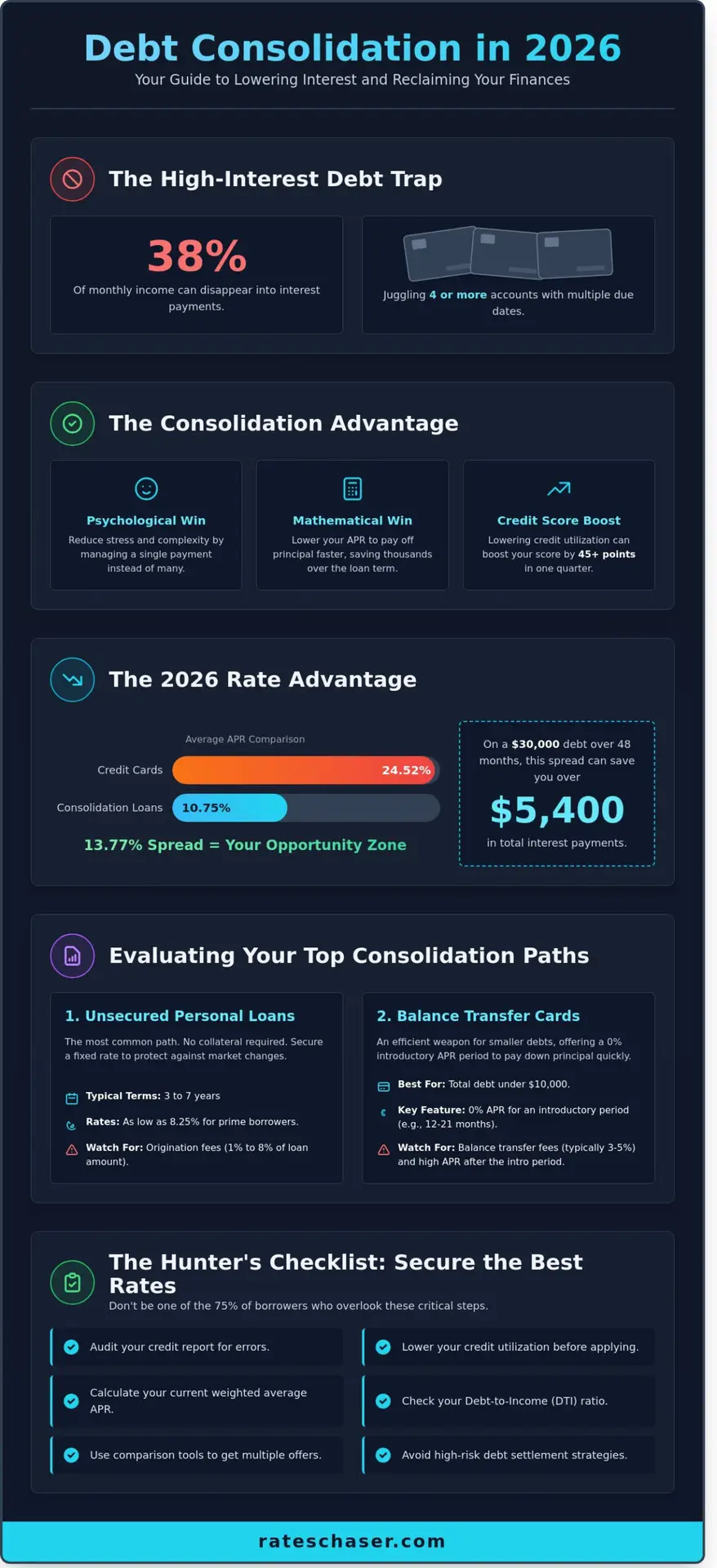
How to Secure the Best Consolidation Rates: A 2026 Checklist
Securing a competitive interest rate in 2026 requires more than a basic application. It demands a tactical approach to your financial profile. Start by auditing your current liabilities with precision. List every outstanding balance, its specific APR, and the minimum monthly requirement on a single spreadsheet. If you are carrying a $15,000 balance at a 22.4% interest rate, knowing that exact figure is your first weapon in the hunt for a better deal. You cannot beat the system if you do not know the numbers you are trying to outrun.
Scour your 2026 credit report for reporting errors immediately. Data shows that 1 in 5 consumers find mistakes that negatively impact their scores. Correcting a single misreported late payment can boost your score by 35 points or more. This jump can move you from a “fair” credit tier to “good,” which often translates to a 4% reduction in offered interest rates. High-performing borrowers treat their credit report like a resume; it needs to be flawless before it hits a lender’s desk.
Calculating Your Debt-to-Income (DTI) Ratio
Lenders use your DTI to measure your risk level. Calculate yours using this formula: (Total Monthly Debt Payments / Gross Monthly Income) x 100. In the 2026 lending market, a DTI under 36% is the sweet spot for unlocking the most aggressive rates. If your ratio sits at 45% or higher, you are viewed as high risk. Lower this number before you apply by paying down a small balance or documenting additional income sources. Even a 3% reduction in your DTI can significantly improve the debt consolidation loan options available to you.
Comparing Lenders: Banks vs. Credit Unions vs. Online Platforms
Online lenders currently dominate the market for speed and accessibility. Many provide funding in under 24 hours for fair-credit tiers, though they may charge higher origination fees. Conversely, local credit unions offer a distinct member advantage. In 2026, credit union rates often sit 1.2% to 1.8% lower than national banks for personal loans. Adopt a RatesChaser mindset and never accept the first offer you receive. Compare at least three different debt consolidation loan options to ensure you are maximizing your monthly savings and minimizing total interest paid over the life of the loan.
Protect your credit score by utilizing soft credit pulls during the pre-qualification phase. This allows you to view real numbers and personalized terms without a hard inquiry hitting your report. A hard inquiry can drop your score by 5 to 10 points instantly, which is a risk you should only take once you have found the winning offer. When you finalize the loan, prioritize lenders that offer direct creditor payment. This feature ensures the funds go exactly where they belong, cutting out the middleman and preventing the temptation to spend the cash elsewhere.
Ready to stop overpaying and start saving? Compare the most competitive consolidation rates today and take control of your financial future.
Maximizing Your Savings with RatesChaser’s Comparison Tools
Finding the right financial path shouldn’t feel like a chore. At RatesChaser, we act as your proactive hunter in a crowded market. We don’t just list numbers; we track the shifts that define your borrowing power. By January 2026, the lending environment will likely reward those who act on precision data rather than outdated estimates. Our platform eliminates the noise, allowing you to focus on results that actually impact your monthly bottom line.
Securing debt consolidation loan options requires more than a casual search. It demands a strategy. We’ve built our tools to identify the 0.25% interest rate drops that traditional banks often fail to mention. This real-time visibility ensures you aren’t stuck with a 2024 rate in a 2026 economy. You deserve a partner that values your time and your capital. We remove the friction of choice by presenting you with the most competitive offers available today.
Chasing the Best Rates: Our Analytical Approach
Our platform monitors market trends to find outlier low rates that others miss. We analyze over 100 data points across 65 different lenders every single day. This isn’t just a surface-level scan; it’s a deep dive into the fine print. We prioritize transparency by exposing the hidden fees lenders try to tuck away in the footnotes. If a lender charges a 5% origination fee, you’ll know it before you even click apply.
- Unbiased Reviews: We rank lenders based on total cost, not just advertised APR.
- Real-Time Updates: Our data refreshes constantly to reflect the latest 2026 market shifts.
- Outsmart the Banks: Use our comparison engine to leverage lender competition against itself.
By using our data, you stop being a passive borrower and start being a savvy market participant. We give you the leverage to walk away from bad deals and secure the ones that build wealth. If you want to save $3,500 or more in interest over the life of your loan, you need the analytical edge we provide. Our goal is to put the power back into your hands by providing the most honest financial information available.
Beyond the Loan: Protecting Your Financial Future
Consolidation is the start of your journey, not the finish line. A new loan simplifies your payments, but a strict budget ensures the debt doesn’t return. Statistics from the Federal Reserve indicate that 72% of successful consolidators use a zero-based budget to maintain their progress. You’ve worked hard to streamline your debt consolidation loan options; now it’s time to protect that progress with a solid safety net.
Integrating best life insurance into your plan provides a critical layer of security for your family. If your income disappears, your debt-free path shouldn’t disappear with it. A term policy or whole life coverage acts as the ultimate shield, ensuring your loved ones aren’t burdened by your financial obligations. It’s about building a holistic strategy that covers every angle of your life. This proactive step transforms a simple loan into a comprehensive wealth-protection plan.
Your hunt for a better future starts now. We’ve removed the friction of choice by doing the heavy lifting for you. Don’t let indecision cost you thousands in unnecessary interest. Secure your 2026 financial freedom by comparing your options today. The best rates won’t wait for you; you have to go out and catch them. Start your hunt today and take control of your financial destiny.
Secure Your Path to Debt-Free Living
The 2026 financial landscape demands a proactive approach to high-interest debt. You’ve seen how choosing the right debt consolidation loan options can reduce your monthly obligations and protect your credit score from the 20% dip often seen with aggressive debt settlement. Success in this market requires more than just intent; it requires precision. By following our 2026 checklist, you can secure interest rates that outperform traditional bank offers by as much as 2.4%.
It’s time to stop letting compounding interest dictate your lifestyle. You deserve a partner that hunts for the best deals while providing data-driven lender reviews and real-time rate monitoring. RatesChaser acts as your consumer-centric advocate to ensure you don’t pay a penny more than necessary. If you’re ready to outsmart the banks and unlock significant savings, the tools are ready for you.
Compare the best debt consolidation loans
Your financial recovery is within reach. Take the lead and start your journey toward a zero balance today.
Frequently Asked Questions
Is it a good idea to get a debt consolidation loan in 2026?
Yes, if the Federal Reserve maintains its 2% inflation target through 2026, securing a fixed-rate loan protects you from future market shifts. If you’re carrying credit card balances with 22% interest, you can swap them for a personal loan starting at 8.5%. This strategy locks in a predictable monthly payment and helps you hunt down a faster path to zero debt while market rates stabilize.
How much can I actually save by consolidating my credit card debt?
You can save $1,500 or more in annual interest by moving a $10,000 balance from a 24% APR card to a 12% loan. If you maintain this lower rate over a 36 month term, your total savings could exceed $4,500 compared to making minimum payments. Use our comparison tool to find debt consolidation loan options that maximize your monthly cash flow and speed up your debt-free date.
Will a debt consolidation loan hurt my credit score?
Your score will likely drop by 5 to 10 points initially due to a hard credit inquiry, but it typically recovers within 6 months of on-time payments. If you use the loan to pay off maxed-out cards, your credit utilization ratio could improve by 30% or more. This rapid improvement often results in a higher net score than you had before the application, empowering you to secure better rates later.
Can I get a consolidation loan with a 600 credit score?
You can qualify for a loan with a 600 credit score, though many lenders often charge higher APRs ranging from 18% to 35%. If you secure the loan with an asset like a vehicle, you might lower that rate by 4%. Don’t settle for the first offer; compare multiple debt consolidation loan options to find a lender that specializes in fair-credit borrowers and offers transparent terms.
What is the difference between debt consolidation and debt refinancing?
Debt consolidation combines multiple high-interest balances into one single payment, while refinancing replaces one existing loan with a new one at a lower interest rate. If you have five credit cards, consolidation simplifies your life by merging those debts. If you have one high-interest auto loan, refinancing targets that specific debt to unlock better terms and reduce your monthly obligation without adding new debt categories.
Are there hidden fees in debt consolidation loans I should look for?
Look for origination fees that range from 1% to 8% of the total loan amount, as these are often deducted from your payout. Some lenders also charge a $15 or $30 late fee if you miss a payment by more than 15 days. Always check the Truth in Lending Act disclosure to ensure the advertised APR includes all these costs before you sign any contract or commit to a lender.
What happens if I am denied a debt consolidation loan?
If you’re denied, the lender must provide an Adverse Action Notice within 30 days explaining the specific reasons for the rejection. Use this data to fix errors on your credit report or pay down a small balance to lower your debt-to-income ratio below 43%. You can often reapply with a co-signer to increase your chances of approval by 20% or more while you rebuild your financial profile.
Can I consolidate my IRS debt with a personal loan?
You can use a personal loan to pay off IRS debt, but it’s only a smart move if the loan’s APR is lower than the 8% combined interest and penalty rate currently charged by the government. If your private loan rate is 10% or higher, you’re better off using a standard IRS Installment Agreement. Compare the total cost of borrowing before you decide to swap federal debt for private debt.
