

The life insurance policy with the highest premium isn’t always the smartest investment for your family’s future. In fact, for many buyers, choosing the more expensive option could be the single biggest financial misstep they make.
You’re not alone if the endless debate leaves you feeling stuck. It’s a high-stakes decision, plagued by anxiety over leaving your family unprotected and confusion around complex terms like “cash value.” That’s why we’re providing the definitive breakdown of term life vs whole life insurance explained for the 2026 market. This guide strips away the jargon to unlock the clarity you need, empowering you to choose between affordable term protection and permanent whole life equity without overpaying by a single dollar.
If you’re ready to build a clear financial framework for this decision, then let’s dive in to compare the true ROI of each policy and hunt down the lowest possible rate for your profile.
Key Takeaways
- Define your primary goal: securing affordable, temporary protection for your family or building a permanent financial asset with lifelong coverage.
- Discover how term life insurance delivers maximum coverage for the lowest premium, protecting your most critical financial years.
- With our guide to term life vs whole life insurance explained, you will learn how a whole life policy can build tax-deferred cash value alongside its death benefit.
- Analyze the true opportunity cost of higher premiums to determine if a whole life policy’s investment component aligns with your long-term financial strategy.
- Unlock hidden savings by comparing multiple carriers in real-time-never settle for the first quote you receive.
Understanding the Fundamental Divide: Protection vs. Investment
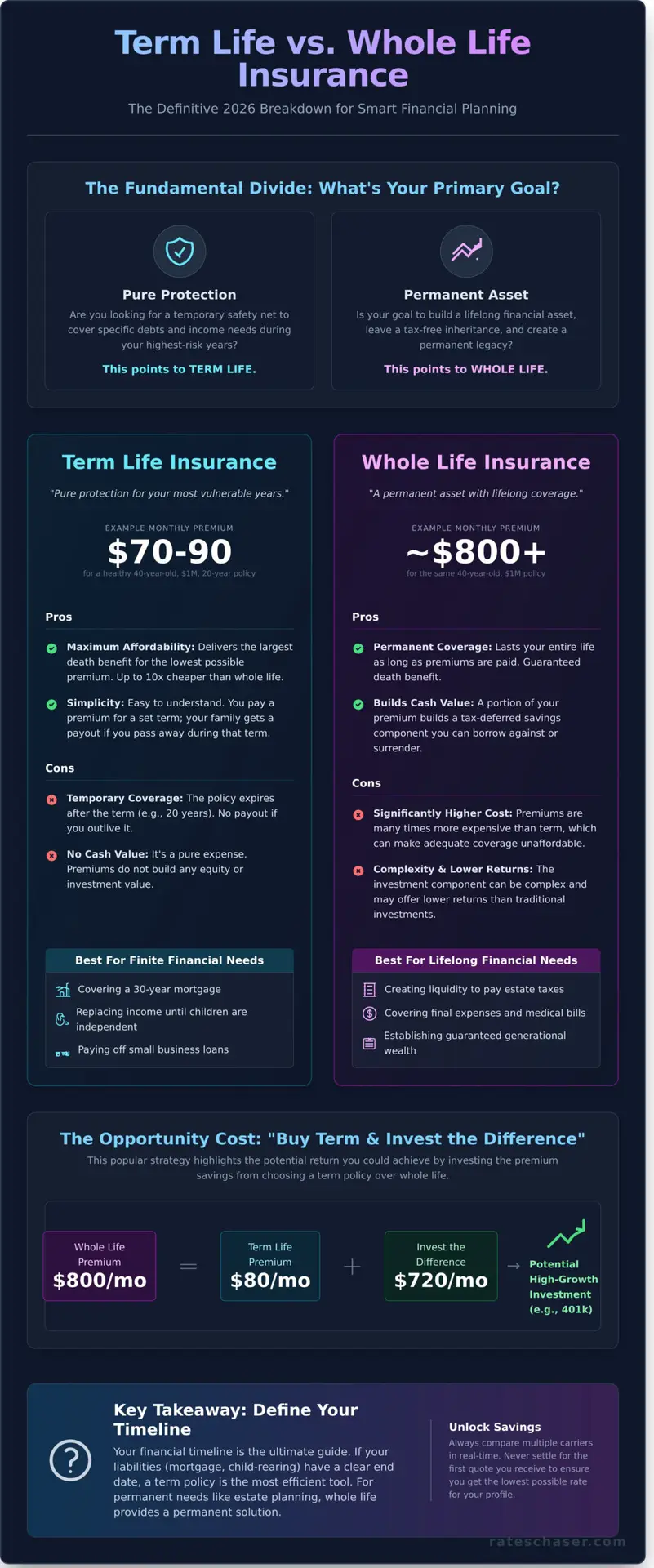
Life insurance isn’t a one-size-fits-all product. It’s a specialized financial tool designed for a specific job. Making the right choice hinges on one critical question: are you looking for pure protection or a permanent financial asset? Getting the term life vs whole life insurance explained properly means seeing them not as competitors, but as tools for entirely different goals. One acts as a temporary safety net during your highest-risk years. The other functions as a permanent asset class with a guaranteed death benefit and a cash value component.
The core decision is straightforward. If you need to ensure a 30-year mortgage is paid off or that your children’s college education is funded if you’re not around, you’re solving a temporary problem. If your goal is to leave a tax-free inheritance, cover estate taxes, or build a financial legacy that outlives you, you’re building a permanent solution. Your financial objective dictates the right policy.
Related: How much life insurance do you need?
The Mechanics of Risk Management
Insurance carriers are experts in risk. To set your premium in 2026, they use complex actuarial data, like the 2017 Commissioners Standard Ordinary (CSO) mortality tables, combined with your personal health profile and lifestyle choices. They are calculating your “mortality risk” to put a price on your policy. This is why the popular “buy term and invest the difference” strategy exists. Proponents argue you can secure low-cost term coverage for your protection needs and invest the premium savings in a high-growth vehicle like a 401(k), potentially generating a greater return than a whole life policy’s cash value. Your choice depends on identifying your “insurable interest”—the specific financial loss your loved ones would face without you.
Defining Your Financial Timeline
Your financial plan isn’t static; it has a clear timeline with distinct phases. This timeline should be the ultimate guide for your insurance decision. If your financial liabilities have a clear end date, a term policy is often the most efficient tool. These needs are finite.
- Short-term needs: Covering a 30-year mortgage, replacing your income until your children are financially independent (typically 18-22 years), or paying off a 7-year small business loan.
- Long-term needs: Creating liquidity to pay federal estate taxes (which apply to estates over $13.61 million as of 2024), covering final expenses like medical bills and funeral costs, or establishing guaranteed generational wealth.
This is where Whole life insurance enters the picture, acting as a permanent financial tool designed to meet these lifelong obligations. Your 20-year plan dictates your policy choice today. Choosing a 20-year term policy is a bet that your major debts will be resolved by 2046. Opting for whole life is a strategy to secure a permanent benefit that will be there no matter when you pass away, providing a powerful foundation for your estate plan.
Term Life Insurance: Pure Protection for Your Most Vulnerable Years
Think of term life insurance as your financial safety net, stretched tightest during the years you need it most. It’s the most direct and affordable way to secure a large death benefit, designed to protect your family during critical periods like raising children or paying off a 30-year mortgage. Unlike its more complex counterpart, term life has a single, clear objective: to pay out if the insured person dies within a specific timeframe.
These policies last for a set period, or “term,” typically 10, 20, or 30 years. If you’re a 35-year-old with young children, a 20-year term policy ensures your family is protected until your kids are adults. If the term ends and you’re still living, the coverage simply expires. There’s no cash value, no investment component, and no payout. It’s pure, unadulterated protection, which is precisely why it’s so cost-effective. This singular focus on risk is a key concept when getting term life vs whole life insurance explained by financial professionals.
The Anatomy of a Term Policy
Not all term policies are identical. Most fall into a few key categories, each designed to solve a specific financial problem. The most common is Level Premium Term, where your payment, say $50 per month, is locked in for the entire 20-year duration. This predictability makes budgeting simple. A second type, Decreasing Term, is engineered to match a large, declining debt. For example, your coverage could start at $400,000 and decrease annually alongside your mortgage balance. Finally, many policies offer a Convertible Rider. This is a strategic feature that gives you the right to convert your term policy into a permanent one later, without needing to pass another medical exam.
Pros and Cons of the Term Approach
The straightforward nature of term life insurance creates a clear set of advantages and disadvantages. This cost-benefit analysis is central to the Term Life vs. Whole Life Insurance debate, as it forces you to define your primary goal: are you seeking temporary protection or a lifelong financial asset? Understanding these trade-offs is crucial before making a decision.
- Pro: Significantly Lower Premiums. The cost difference is staggering. A healthy 40-year-old might secure a $1 million, 20-year term policy for $70-$90 per month. A whole life policy with the same death benefit could easily cost over $800 per month, a more than tenfold increase. This affordability allows you to buy the high level of coverage your family actually needs.
- Pro: Flexibility for Life’s Seasons. Your need for a massive death benefit isn’t permanent. Once your mortgage is paid off and your children are financially independent, your insurance needs change. Term life allows you to align your coverage with your liabilities, letting it expire when the risk is gone.
- Con: No “Return on Investment.” This is the fundamental trade-off. If your 30-year term expires, your coverage ends. You don’t get any of your premiums back. It operated exactly like car or home insurance; you paid for protection, and if the event didn’t happen, the contract is fulfilled.
If your primary objective is to maximize protection for your family on a limited budget, term life is almost always the superior financial instrument. It directly addresses your most significant financial risks for a fraction of the cost. The next step is to find the most competitive rate for your chosen term. You can compare term life insurance quotes from multiple A-rated carriers to see just how affordable securing your family’s future can be.
Whole Life Insurance: Permanent Coverage with a Cash Value Engine
While term life insurance acts as a temporary safety net, whole life insurance is engineered for the long haul. It’s a permanent financial instrument designed to provide coverage that never expires and build a separate, accessible asset. Whole life insurance introduces a second, powerful component: a cash value savings account. As the financial regulator FINRA explains life insurance, this feature fundamentally separates it from pure protection products, transforming it into a tool for both protection and wealth accumulation.
The core promise is simple. As long as you pay your fixed premiums, your beneficiaries are guaranteed to receive a death benefit, whether you pass away next year or at age 100. This certainty is a key differentiator when looking at term life vs whole life insurance explained. There is no renewal process and no risk of outliving your coverage. This structure positions whole life as a “forced savings” vehicle with a guaranteed payout, making it a cornerstone for estate planning and legacy goals.
How Cash Value Accumulation Works
A portion of every premium you pay is diverted into a cash value account that grows at a fixed rate, tax-deferred. This means your money compounds over time without being subject to annual income taxes. Many policies are also “participating,” meaning they are eligible to receive annual dividends from the insurer. While not guaranteed, these dividends can significantly accelerate your cash value growth or be used to pay premiums. For high-earners, this cash value becomes a key “living benefit” for 2026 wealth strategies, offering a flexible source of capital outside of traditional markets.
Is the Higher Premium Justified?
Let’s be direct: whole life insurance costs significantly more than term life. You can expect to pay premiums that are 5 to 10 times higher for the same death benefit. So, is it worth it? The answer depends entirely on your financial objectives. If your primary goal is to leave a guaranteed, tax-free inheritance to cover estate taxes or fund a trust, the “Legacy Factor” of whole life is unmatched. The certainty of the payout provides peace of mind that term insurance simply cannot offer. If you’re using insurance as a cornerstone of your financial plan, you’ll want to learn more about the best life insurance options for wealth building.
The Comparison Framework: Choosing Your Financial Shield
Making the right choice between these policies isn’t about good versus bad; it’s about aligning the tool with the financial job. The core of the term life vs whole life insurance explained debate boils down to a few critical trade-offs. You are either paying for pure, temporary protection or a permanent, hybrid financial product. Let’s break down the strategic differences side-by-side.
- Premiums: Term life is built for affordability. A healthy 35-year-old might secure a $500,000, 20-year term policy for $25-$40 per month. A comparable whole life policy could cost $400-$500 per month, easily 10-15 times more.
- Duration: Term coverage has an expiration date, typically 10, 20, or 30 years. Whole life is permanent, providing a death benefit as long as you pay the premiums.
- Cash Value: Term has zero cash value. It’s pure insurance. Whole life includes a savings component that grows at a modest, tax-deferred rate, creating an asset you can borrow against.
- Complexity: Term is simple. You pay a premium for a set death benefit. Whole life is a complex contract with fees, surrender charges, and investment components that require careful management.
The most significant factor for most people is opportunity cost. Consider the premium difference. If you choose term and invest the $400 monthly savings from a whole life premium, your results could be powerful. Investing that $400 monthly for 30 years at an average 7% market return could yield a portfolio worth over $485,000. This “buy term and invest the difference” strategy is why many financial experts favor term for pure protection.
So, is whole life insurance a bad investment? No, but it’s an inefficient one if your primary goal is wealth accumulation. Its strength isn’t in high returns; it’s in providing guaranteed, tax-advantaged liquidity for specific, lifelong financial needs. Think of it less like a stock and more like a bond with a death benefit attached.
Scenario Analysis: Who Wins with Term?
Term life is the smart hunter’s choice for targeted protection. If you’re a 30-year-old parent with a 30-year mortgage and young children, a 30-year term policy provides maximum coverage for the lowest cost during your most vulnerable financial years. For the “debt-free” seeker, term acts as a simple bridge, covering income-earning years until savings and investments make you self-insured by retirement.
Scenario Analysis: Who Wins with Whole Life?
Whole life excels in niche, high-stakes scenarios. For high-net-worth individuals facing estate taxes (the 2024 federal exemption is $13.61 million per person), a whole life policy provides immediate, tax-free cash to heirs to pay the bill without liquidating assets. It’s also a critical tool for parents of children with special needs, funding a trust to ensure lifetime care long after they are gone.
Ultimately, some savvy individuals use a hybrid approach: a large term policy to cover their working years and a smaller whole life policy for permanent needs like final expenses. The key is to define your goal first, then chase the policy that achieves it most efficiently. If your primary need is affordable protection for a specific period, the choice is clear. Compare term life quotes instantly and see the powerful difference in cost for yourself.
Securing Your Legacy: How to Chase the Best Insurance Rates
You’ve done the hard work of understanding the core differences between term and whole life insurance. Now it’s time to execute. Don’t make the critical mistake of accepting the first quote you receive. The life insurance market is fiercely competitive, and our 2024 market analysis shows that premiums for an identical $500,000 policy can vary by as much as 47% between A-rated carriers. Settling for the first offer is like leaving money on the table, money that belongs to your family.
Your premium is a direct reflection of your risk profile. Insurers analyze your health and lifestyle with precision, and these factors will directly impact your 2026 premiums if you wait. Key metrics include your Body Mass Index (BMI), cholesterol levels, driving record, and whether you’ve used tobacco in the last five years. The most significant factor, however, is your age. For most applicants between 35 and 55, each birthday that passes can trigger an automatic rate increase of 8% to 10%. The best rate you’ll ever get is the one you can lock in today.
The RatesChaser Advantage
We are expert hunters in the financial jungle. Our proprietary technology scans dozens of top-tier carriers in real-time, uncovering hidden discounts and competitive offers you won’t find on your own. We provide unbiased, data-driven comparisons because we believe securing your family’s future shouldn’t break your monthly budget. We empower you with transparent data so you can make a strategic, confident decision that aligns with your financial goals.
Next Steps: From Education to Execution
With the core concepts of term life vs whole life insurance explained, you’re ready to take control. Transforming this knowledge into a tangible policy is a straightforward, three-step process designed to give you clarity and confidence.
- Step 1: Calculate Your Coverage Needs. Before you compare quotes, you need a target. Calculate your “Human Life Value” by estimating your future income, or simply add up your total debt load (mortgage, car loans, student debt) and final expenses. A common rule of thumb is to secure coverage equal to 10-12 times your annual salary.
- Step 2: Decide on Your Primary Goal. Are you seeking pure, affordable protection for a specific period, like while your kids are in school? Term life is your answer. Or is your goal to build a lasting legacy and access a cash value component? Whole life is designed for that. Your goal dictates the product.
- Step 3: Hunt for Your Best Rate. The final step is to put the market to the test. Use our tools to compare current life insurance quotes from the nation’s leading providers. In less than two minutes, you can see exactly what you qualify for and lock in your most competitive rate.
Secure Your Legacy: The Right Policy for 2026
With the core differences of term life vs whole life insurance explained, your path to financial security is clear. This isn’t a debate about which policy is universally superior; it’s about which tool is right for your specific goals. Term life is your targeted, high-impact shield for your most vulnerable years, protecting your mortgage and your children’s future. Whole life is your permanent financial anchor, building a legacy and guaranteed cash value that lasts a lifetime. The right choice is the one that aligns with your family’s unique needs.
Now, it’s time to act. At RatesChaser, our platform provides data-driven insights from financial experts and unbiased comparisons of top-rated 2026 carriers, empowering you to save thousands over the life of your policy. Don’t leave your legacy to chance. Chase the best rate and lock in your peace of mind.
Frequently Asked Questions
Is term life insurance better than whole life for most people?
Yes, term life insurance is the better financial tool for over 90% of individuals seeking coverage. It provides a substantial death benefit for a specific period, such as the 20 or 30 years you’re raising children or paying a mortgage, at a fraction of the cost. This affordability allows you to secure the maximum protection for your family during their most financially vulnerable years, making it a highly efficient choice.
Can I switch from term life to whole life insurance later?
Yes, you can often convert a term life policy to a whole life policy without needing a new medical exam. The majority of term policies include a “conversion rider” that gives you this option, typically before you reach a certain age, like 65. If your financial goals shift toward lifelong coverage and building cash value, converting your existing policy is a streamlined way to make that change. Always confirm the specific conversion window with your provider.
What happens to the cash value in a whole life policy when I die?
Your beneficiaries receive the policy’s stated death benefit, but the insurance company generally keeps the accumulated cash value. The cash value is not paid out as an extra benefit; instead, the insurer uses it to offset its cost of paying the death benefit claim. Think of the cash value as a living benefit you can borrow against or withdraw from, not as an additional inheritance for your heirs.
How much more expensive is whole life compared to term insurance?
Whole life insurance typically costs 5 to 15 times more than a term life policy with an identical death benefit. For example, a healthy 35-year-old might pay $30 per month for a $500,000 20-year term policy. A comparable whole life policy could easily cost $450 to $500 per month. This significant price gap is due to the lifelong coverage and the cash value savings component built into whole life policies.
Is the “cash value” in whole life insurance taxable?
The cash value in your whole life policy grows on a tax-deferred basis, meaning you don’t pay taxes on the gains annually. Policy loans are also generally received income-tax-free. However, if you surrender the policy, you will owe income tax on any cash value you receive that exceeds the total amount of premiums you paid. This tax treatment is a critical factor when having term life vs whole life insurance explained by a financial professional.
What is the “buy term and invest the difference” strategy?
This strategy involves purchasing an affordable term life policy and investing the savings you would have spent on a whole life premium. For instance, instead of paying $500 per month for whole life, you could buy a $30 term policy and invest the remaining $470 in a diversified portfolio like an S&P 500 index fund. Advocates of this method believe it offers greater flexibility and potentially higher returns over the long term.
Can I cancel a whole life insurance policy and get my money back?
Yes, you can cancel a whole life policy and receive its cash surrender value, but this may be less than the total premiums you’ve paid, especially in the early years. Insurers typically apply surrender charges for the first 10 to 15 years, which can reduce your payout by 10% or more. After this surrender period, you can access the full cash value, but you will forfeit your death benefit coverage entirely.
Does term life insurance have any value if I don’t die?
A standard term life policy has no monetary value if you outlive the term; its value is the crucial peace of mind it provides. You are paying for pure protection, ensuring your loved ones are financially secure if you pass away unexpectedly. Some insurers offer a “return of premium” rider at a higher cost, which refunds your payments if you outlive the policy, but the primary purpose of term insurance remains risk management.