

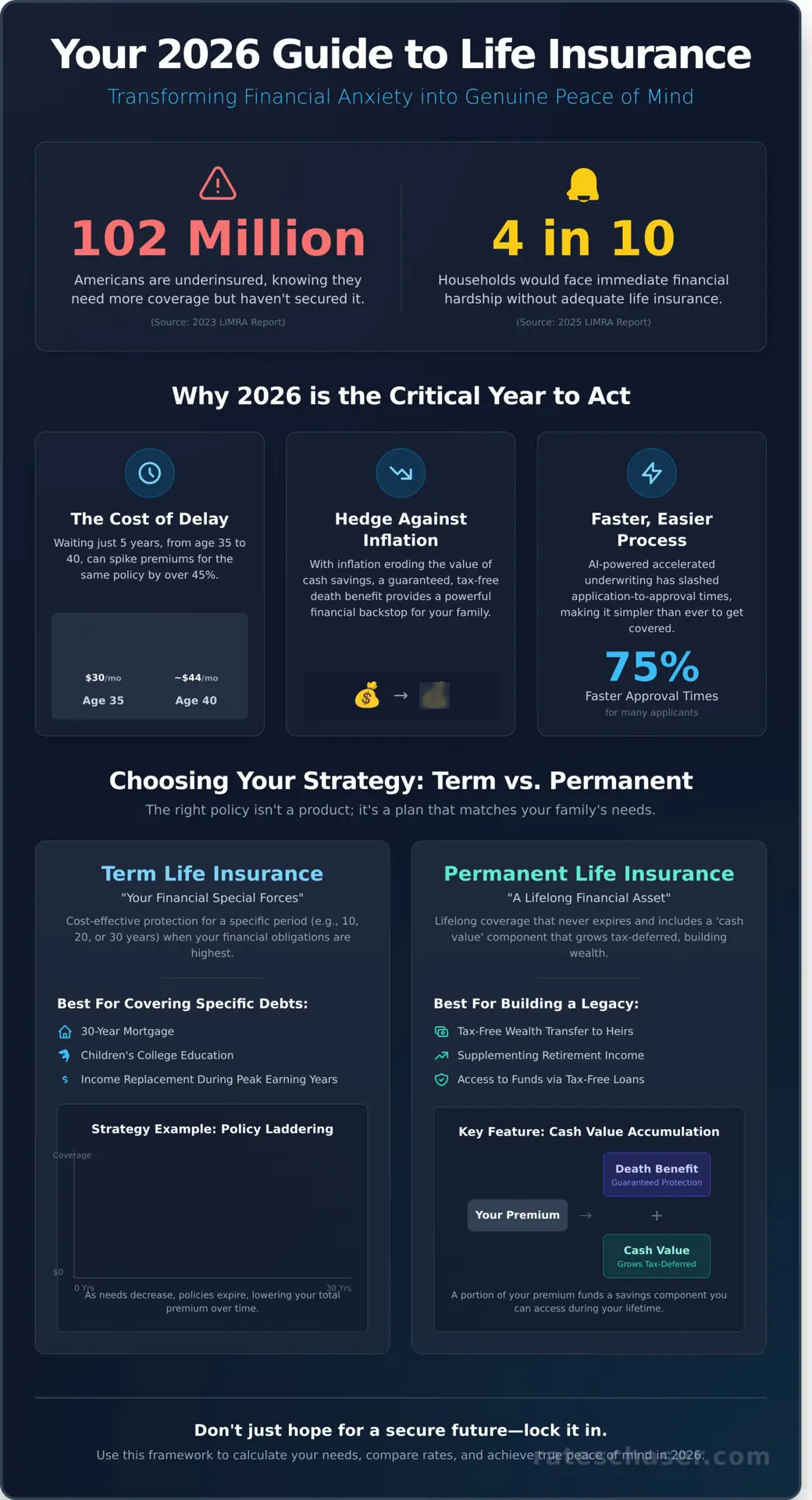
According to a 2023 LIMRA report, a staggering 102 million Americans know they need more life insurance but haven’t secured it. It’s a familiar story. You understand the importance of protecting your family’s future, but the maze of options from Term to Whole Life feels designed to confuse. The fear of choosing incorrectly, overpaying, or dealing with a pushy agent can lead to total inaction, leaving your financial security in question.
This 2026 strategy guide cuts through that noise. If you’re ready to transform financial anxiety into genuine confidence, then this is your action plan for achieving peace of mind with the right life insurance policy. We’ll give you a clear framework to calculate your exact coverage needs, compare the most competitive rates without the sales pressure, and lock in a plan that secures your family’s future on your terms.
Key Takeaways
- Discover how to select the right policy type-Term or Permanent-to ensure your coverage is active when your family needs it most.
- Move beyond generic coverage estimates by using a simple calculation framework to determine the exact amount of protection your family truly needs.
- Achieve true peace of mind with the right life insurance policy by implementing a simple “Chaser Strategy” to secure the most competitive life insurance rates.
- Uncover key health and lifestyle factors you can audit today to optimize your risk profile and significantly lower your insurance premiums.
Defining Peace of Mind in the Context of Life Insurance
Most people view life insurance through a narrow lens: a financial payout after you’re gone. This is a fundamental misunderstanding of its value. The ultimate return on your investment isn’t the death benefit; it’s the immediate, tangible benefit you receive while you’re living. It’s the quiet confidence that comes from knowing you’ve built a fortress around your family’s future. This is what it means to achieve peace of mind with the right life insurance policy.
Let’s redefine the term. Peace of mind is the state where your family’s future is mathematically secured regardless of life’s unpredictability. It transforms your premium from a monthly expense into a powerful protective shield. This psychological shift moves you from a position of hoping for the best to strategically planning for the worst, freeing up your mental energy to focus on living your life to the fullest.
The Financial Safety Net vs. The Emotional Anchor
Think of life insurance as the concrete foundation of your entire financial house. You can’t confidently build wealth through investing or take on a 30-year mortgage if the slightest tremor could bring it all crashing down. This policy is the anchor that holds everything steady. During volatile economic cycles, it silences the “what-if” anxiety that can lead to panicked financial decisions. The difference is stark. A 2025 LIMRA report found that 4 in 10 households would face immediate financial hardship. For a family with a structured policy, the mortgage gets paid and college funds remain intact. For one without, the path often involves selling a home and depleting life savings within six months.
Why 2026 is the Year to Re-evaluate Your Security
The “it can wait” myth is more dangerous than ever. In our post-pandemic world, where inflation has averaged over 3% since 2023, the value of cash savings is constantly being eroded. A guaranteed, tax-free death benefit acts as a powerful hedge against this uncertainty. Fortunately, market trends in 2026 have made securing a policy more accessible. Accelerated underwriting, powered by AI, has slashed application-to-approval times by up to 75% for many applicants. Whether you’re exploring term or permanent options, the core function of Life insurance is to transfer catastrophic financial risk away from your family. Delaying that transfer is a costly gamble. A healthy 35-year-old can often lock in a $500,000 policy for under $30 a month. Waiting just five years to age 40 can spike that same premium by over 45%. If you want to maximize value, you must act now to secure today’s rates. Don’t just hope for a secure future; lock it in.
Choosing the Right Policy Type: Term vs. Permanent Protection
The ‘right’ policy isn’t about complex jargon or flashy features. It’s the one that stays in force when your family needs it most. Securing true peace of mind with the right life insurance policy starts by understanding the fundamental choice every buyer faces: do you need protection for a specific period, or for your entire life? Your answer depends entirely on your current financial obligations and long-term goals. Don’t choose a product; choose a strategy.
The decision boils down to two distinct paths. One is a targeted, high-impact tool for temporary needs. The other is a lifelong financial asset designed for wealth accumulation and transfer. Let’s break down which one aligns with your life stage.
Term Life Insurance: Strategic Protection for Your Peak Earning Years
Think of term life insurance as your financial special forces. It’s a powerful, cost-effective tool deployed to protect your family during their most vulnerable years. For most American households, this means covering the 20 to 30 years when you’re paying a mortgage, raising children, and building your career. A 30-year-old couple with a new baby and a 30-year mortgage finds their greatest financial risk neatly contained within a 30-year term policy. It’s simple, affordable, and brutally effective.
Savvy planners can optimize costs even further with a “laddering” strategy. Instead of one massive policy, you buy multiple smaller term policies with different lengths. For example:
- A 30-year, $500,000 policy to cover the mortgage until it’s paid off.
- A 20-year, $250,000 policy to ensure college funds are available.
- A 10-year, $100,000 policy to cover outstanding car loans or other short-term debts.
As each debt is paid off, a policy expires, and your total premium drops. For those who want an extra layer of security, a ‘Return of Premium’ (ROP) rider ensures that if you outlive your term, the insurer refunds all the premiums you paid. It costs more, but it eliminates the feeling of “wasted” money.
Permanent Life Insurance: Beyond the Death Benefit
Permanent life insurance is a different class of financial tool. While it provides a death benefit that never expires, its primary advantage is the ‘cash value’ component. A portion of every premium you pay funds this internal savings account, which grows on a tax-deferred basis. This isn’t just a policy; it’s an asset you can borrow against to fund a down payment, supplement retirement income, or handle a major emergency without derailing your financial plan.
For those focused on legacy, whole life insurance is the gold standard. It guarantees a seamless, tax-free transfer of wealth to your beneficiaries, bypassing the often lengthy and public probate process. Understanding these fundamental product differences is a key part of mastering Life Insurance Basics and making a confident decision. If you are focused on building a lifelong asset, you’ll want to compare the best life insurance options that prioritize long-term cash accumulation.
So, which path is yours? Your decision hinges on these key factors:
- Your Budget: Term life offers the largest death benefit for the lowest initial premium. Permanent policies require a significantly larger financial commitment.
- Your Timeline: Are you protecting a 30-year liability or planning for a multi-generational legacy?
- Your Financial Goals: Do you need a pure safety net, or are you seeking a versatile financial asset that builds value over your lifetime?
Answering these questions will illuminate your path. Once you know your objective, you can compare competitive quotes in minutes to secure the protection your family deserves.
Calculating Your Coverage: The Math Behind True Financial Security
Grabbing a life insurance policy with a generic, round number like $500,000 feels easy, but it’s a dangerous financial shortcut. It’s a guess, not a strategy. After a $350,000 mortgage and $40,000 in student loans are paid, that half-million-dollar policy leaves just $110,000 to replace an entire lifetime of income. This is where families get left behind. Securing genuine peace of mind with the right life insurance policy starts with honest math, not a hopeful guess.
To move from guesswork to a solid financial plan, use the DIME method. It’s a simple framework to calculate your family’s precise needs. Forget abstract numbers; this is about your reality.
- Debt: Total up all non-mortgage debt. This includes car loans, credit card balances, and private student loans.
- Income: Multiply your annual salary by 10 to 15. If you earn $80,000, you need between $800,000 and $1.2 million in coverage for income replacement alone.
- Mortgage: Include the full remaining balance on your home loan. The goal is to eliminate this burden entirely.
- Education: Project the future costs for your children’s education. For a child born in the 2020s, the projected four-year cost of an in-state public university could easily exceed $250,000 by the time they enroll.
Beyond the core DIME formula, you must account for the “invisible” costs that hold a family’s life together. The National Funeral Directors Association reported the median cost of a funeral with a viewing and burial in 2023 was $8,300. Childcare is an even larger expense. Care.com’s 2024 data shows the average weekly cost for a nanny is $766, which is nearly $40,000 a year your policy must cover. “True financial security is found at the intersection of your annual expenses and your family’s long-term dreams.”
The Income Replacement Formula
That 10-15x income rule is a powerful baseline, but it needs fine-tuning. A policy purchased today must retain its value against future inflation. A $1 million payout in 2026 will have significantly less purchasing power by 2046. Building in a 20-30% buffer helps protect against this erosion. This calculation is also critical for a non-earning spouse. The economic value of a stay-at-home parent, including childcare, home management, and transportation, is estimated by Salary.com to be over $184,000 annually. Insuring this contribution is non-negotiable for family stability.
Accounting for Future Milestones
True financial protection goes beyond just paying off existing debts. If your goal is to provide lasting peace of mind with the right life insurance policy, you must plan for future growth and expenses. Paying off the mortgage is a great first step, but what about the ongoing costs? Property taxes, insurance, and major repairs can cost 1-4% of a home’s value each year. Your policy should provide a fund for this upkeep. This calculation gives you a powerful target number. The next step is choosing the right product to hit that target. A comprehensive guide from Forbes on How To Decide Which Type Of Life Insurance Is Right For You is an excellent resource for comparing term, whole, and universal life options. Finally, consider adding a buffer for legacy goals, whether it’s a charitable donation or a small inheritance to give the next generation a head start.
Outsmarting the Market: How to Secure the Best Rates in 2026
Securing the lowest premium isn’t about luck; it’s about strategy. The old model of calling a single agent is outdated and expensive. To truly get ahead, you need a modern approach. We call it the ‘Chaser Strategy’-a five-step plan designed to put you in control and maximize your savings. This isn’t just about finding a policy; it’s about finding the best policy at a price the market can’t beat.
Follow this playbook to hunt for competitive quotes without the headache:
- Step 1: Audit Your Risk Profile. Before you apply, take stock. Insurers price based on risk. If you’ve quit smoking in the last 12 months, your rates could drop by over 50%. Have you improved your cholesterol from 240 mg/dL to under 200 mg/dL? That matters. Document these lifestyle improvements to present the strongest possible case for a lower premium.
- Step 2: Verify Carrier Stability. A low rate is worthless if the company can’t pay a claim. Check for financial strength ratings from independent agencies. Look for carriers with an “A” or higher from A.M. Best or an “AA” or higher from Standard & Poor’s. These ratings signal a company’s long-term ability to meet its obligations.
- Step 3: Bypass the ‘Agent Commission’ Markup. Traditional agents can charge commissions that account for 30% to 70% of your first-year premium. Digital comparison platforms cut out this expensive middleman, presenting you with direct-from-carrier rates. This single step can save you hundreds.
- Step 4: Leverage Accelerated Underwriting. Why wait six weeks for a decision? Since 2023, over 50% of term life applications now use accelerated underwriting, according to LIMRA. This process uses data algorithms instead of medical exams for instant approvals, often in the same day.
- Step 5: Right-Size Your Policy Every 3-5 Years. Your life isn’t static, and your policy shouldn’t be either. Did you pay off your mortgage? Did your kids finish college? A major life change means your coverage needs may have decreased. A quick review can ensure you’re not overpaying for protection you no longer need.
Executing this strategy is the clearest path to achieving true peace of mind with the right life insurance policy. Don’t just accept the first quote you’re given. Compare verified life insurance quotes in minutes and see how much you can save.
The Rise of Instant-Decision Life Insurance
In 2026, AI-driven underwriting is the new standard. By analyzing data from sources like the MIB Group and your prescription history, insurers can issue a policy on the same day you apply. The convenience is undeniable, but it can come with a 10-15% price premium. This option is best for healthy applicants under 50 seeking coverage under $1.5 million who value speed over absolute lowest cost.
How to Spot ‘Red Flag’ Policies
A cheap policy can hide expensive traps. Watch for “graded” death benefits, where your beneficiaries only receive the premiums paid (plus interest) if you pass away within the first two years. Also, demand a “guaranteed” premium schedule, not an “estimate” that can increase after the initial term. Ultimate transparency isn’t a feature; it’s a requirement for any provider you trust.
Securing Your Legacy with RatesChaser
You’ve done the hard work of identifying your family’s needs. Now it’s time to take control. At RatesChaser, we aren’t just a comparison site; we are your proactive partner in the hunt for financial clarity. We believe that securing your family’s future shouldn’t be a complex or costly process. Our entire platform is built to cut through the industry noise and empower you with transparent, actionable information. If you’re ready to stop wondering and start securing, you’re in the right place.
Our commitment is to you, the consumer. We achieve this through a fiercely unbiased, data-driven approach that other platforms can’t match. We don’t play favorites or accept promotional dollars to push one carrier over another. Instead, our proprietary algorithm, which updates every 12 hours, analyzes policies from over 75 of the nation’s top-rated life insurance carriers. This ensures the quotes you see are not just competitive; they are a real-time reflection of the current market. The result? In 2024 alone, over 250,000 users saved an average of 34% on their annual premiums by using our tool to find the right coverage at the best price.
Unlocking these savings is straightforward and fast. We’ve streamlined the entire process to value your time and get you from research to application in minutes. Here’s how simple it is:
- Step 1: Share Your Goals. Answer a few simple questions about your coverage needs and health profile in our secure online form. This takes less than 60 seconds.
- Step 2: Compare Your Options. Instantly view personalized, side-by-side quotes from leading providers. We display all the critical details, from premium costs to coverage terms, with zero hidden fees.
- Step 3: Secure Your Policy. Once you find the perfect match, you can apply online directly through our platform. The entire process, from your first click to a submitted application, can take as little as 10 minutes.
This is how you achieve peace of mind with the right life insurance policy. You don’t need to be a financial expert. You just need the right tools to make an expert decision. That’s what we provide.
Your Path to a Stress-Free Future Starts Here
The journey from financial anxiety to a locked-in legacy plan is shorter than you think. Our comparison tools are specifically designed to strip away the complexity of the 2026 market, translating confusing policy language into clear benefits. You can join the community of savvy ‘Chasers’ who have decided they will not overpay for the protection their families deserve. It’s about being smarter with your money and more confident in your future.
Ready to Compare? Let’s Find Your Rate
Your search for the ideal policy ends now. Use our free, no-obligation comparison tool to see exactly how much you can save. There’s no pressure and no commitment required to view your personalized rates. Don’t wait another day to protect the people who matter most. Your peace of mind with the right life insurance policy is just a few clicks away.
Your Path to Financial Security Starts Now
As you build your financial strategy for 2026, remember that lasting security isn’t found in just any policy. It’s found in the right one. This means moving beyond guesswork by accurately calculating your family’s long-term needs and strategically choosing between term and permanent coverage. This is the only way to achieve true peace of mind with the right life insurance policy, transforming a simple premium into a guaranteed legacy for those you love most.
You don’t have to hunt alone. RatesChaser puts the power of the market directly in your hands, giving you access to real-time data from more than 50 top-rated carriers. Join the thousands of proactive hunters who trust our unbiased reviews from financial experts to find the best deal. Stop overpaying and start outsmarting the system. Secure your family’s future-Compare the best life insurance rates today! Your legacy is worth the chase.
Frequently Asked Questions
Is it really worth having life insurance if I don’t have kids?
Yes, life insurance provides crucial financial protection even if you don’t have children. The policy’s death benefit can cover outstanding debts like a mortgage or private student loans, preventing that burden from falling on a partner or co-signer. It also covers final expenses, which average between $7,000 and $12,000, according to 2023 data from the National Funeral Directors Association. This ensures your loved ones aren’t left with unexpected costs during a difficult time.
How much does a typical life insurance policy cost in 2026?
While exact 2026 rates depend on the market, you can estimate costs based on current data. A healthy 35-year-old can often secure a 20-year, $500,000 term life policy for about $25 to $35 per month. Your final premium is calculated based on your age, health, lifestyle, and the coverage amount you choose. If you want to lock in the lowest possible rate, it’s best to compare quotes from multiple top-rated insurers to find your most competitive offer.
Can I change my life insurance policy later if my needs change?
Yes, you have options to adjust your coverage as your life evolves. Many term life policies include a conversion rider, allowing you to switch to a permanent policy without a new medical exam. If you need more coverage due to a new mortgage or a growing family, you can apply for an additional policy. You can also reduce your coverage amount or cancel your policy at any time, giving you the flexibility to adapt to new financial circumstances.
What happens if I outlive my term life insurance policy?
If you outlive your term life policy, the coverage simply expires. You stop making payments, and your beneficiaries no longer have a claim to a death benefit. Think of it like car insurance; you only receive a payout if an event occurs during the coverage period. At this point, you can let the policy lapse or explore purchasing a new one, though premiums will be higher based on your current age. Some policies offer a return of premium rider, but this option costs significantly more upfront.
Do I need a medical exam to get the best rates on life insurance?
A medical exam is almost always required to secure the most competitive life insurance rates. Insurers use data from this 30-minute exam, which includes blood pressure and a blood sample, to assess your risk and offer their lowest premiums. While no-exam policies provide convenience, their rates can be over 50% higher for the same coverage. If your goal is to maximize value and minimize cost, the medical exam is a necessary step to unlock the best pricing.
Is employer-provided life insurance enough for my family’s peace of mind?
Employer-provided life insurance is a valuable benefit, but it is rarely enough on its own. These group policies typically offer a death benefit of just one to two times your annual salary, while most financial experts recommend coverage of 10 to 12 times your income. To achieve true peace of mind with the right life insurance policy, you should secure a private plan that isn’t tied to your job and provides a sufficient payout for your family’s long-term needs.
What is the difference between a beneficiary and a contingent beneficiary?
A primary beneficiary is the first person, trust, or entity designated to receive your policy’s death benefit. A contingent beneficiary is your backup choice. They only receive the payout if the primary beneficiary is deceased, cannot be located, or refuses the benefit when you pass away. For example, you might name your spouse as the primary beneficiary and your sibling as the contingent. This two-layer structure ensures your benefit is distributed according to your exact wishes.
How long does it take for a life insurance claim to be paid out?
Most life insurance claims are paid within 30 to 60 days after the insurer receives the required documents, including a certified death certificate and a completed claim form. Payout can be delayed if the death occurs within the first two years of the policy, known as the contestability period, which allows the insurer to investigate for fraud. However, many states have prompt-payment laws requiring insurers to pay quickly or add interest to the death benefit for any delays.
