

Your medical history doesn’t have to dictate your family’s financial future.
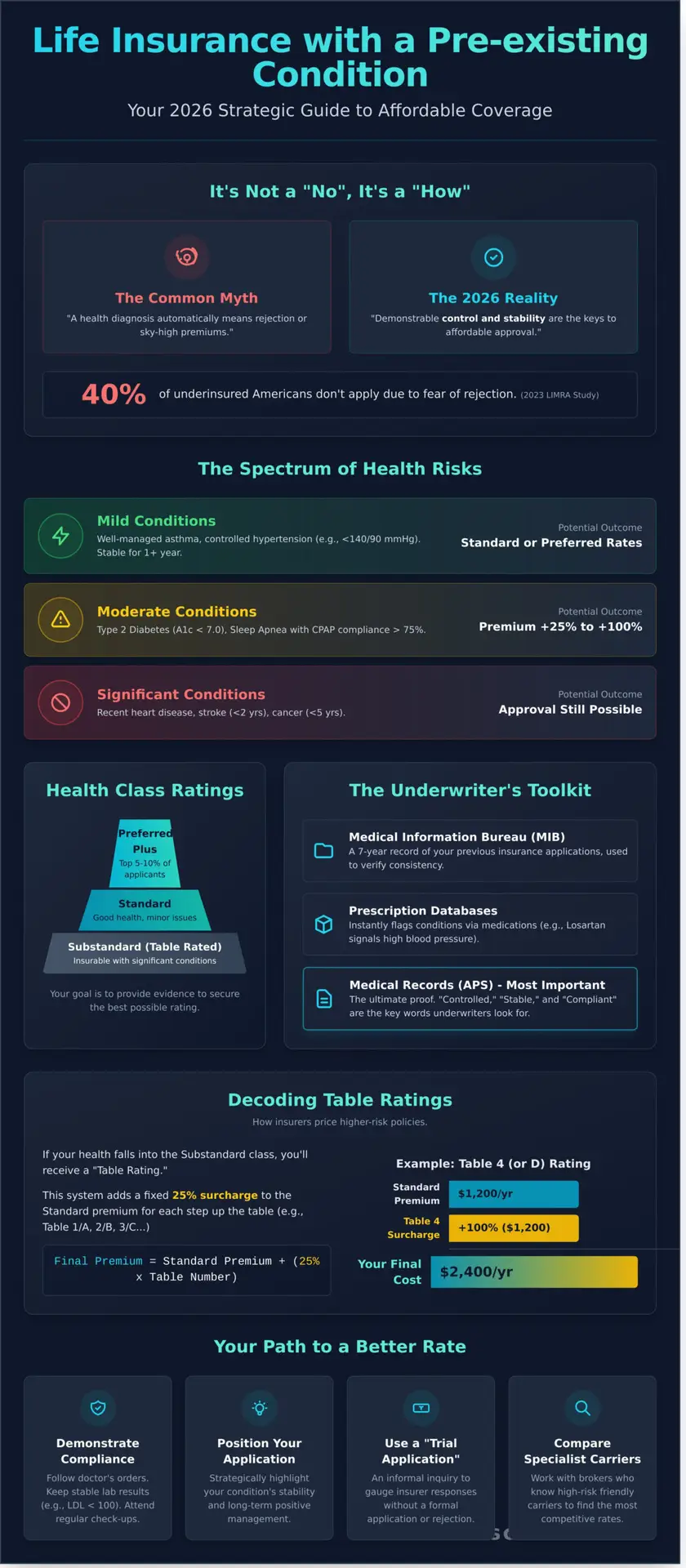
It’s a common belief that a diagnosis like diabetes, heart disease, or even well-managed anxiety automatically closes the door on affordable coverage. You see the application questions about health, and the sticker shock from potential high-risk premiums feels inevitable. The fear of rejection is real, and according to a 2023 LIMRA study, it stops nearly 40% of underinsured Americans from even starting the process.
This 2026 strategic guide is designed to put the power back in your hands. We’ll give you the tactical knowledge to confidently approach the underwriting process, decode medical jargon, and compare specialized policy options you might not know exist. Our goal is simple: to make getting life insurance with a pre-existing condition not just possible, but affordable.
You’re about to learn how to position your health profile for the best outcome, find insurers who specialize in your condition, and finally secure that critical financial safety net for your family.
Key Takeaways
- Understand how underwriters evaluate your health history so you can strategically position your application for the best possible rating.
- Discover the key differences between policy types to select the one that best aligns with your health profile and financial goals.
- Master specific tactics, like using a “trial application,” to maximize your chances of approval when getting life insurance with a pre-existing condition.
- Learn why comparing high-risk friendly carriers is the most effective strategy to secure competitive rates and avoid overpaying for coverage.
What Counts as a Pre-Existing Condition in 2026?
When you’re chasing the best life insurance rates, a pre-existing condition can feel like a roadblock. But it doesn’t have to be. In the world of life insurance, a pre-existing condition isn’t just a diagnosis; it’s any medical issue that an underwriter believes could affect your long-term health and mortality risk. While the technical definition of What Counts as a Pre-Existing Condition can be broad, insurers are focused on one thing: stability. They want to see a clear history of consistent management and treatment.
Your medical history is a key part of the puzzle, but it’s not the only piece. Insurers analyze your condition alongside lifestyle factors like your Body Mass Index (BMI) and smoking status. For example, a non-smoker with a BMI of 24 who manages their high blood pressure with a single medication is a much lower risk than a smoker with a BMI of 35 and the same diagnosis. Control is the name of the game. If you can demonstrate your condition has been stable for a significant period, typically 12 to 24 months with no changes in medication, you dramatically improve your chances of securing a competitive rate.
The Spectrum of Health Risks
Insurers don’t see all health issues the same way. They place conditions on a spectrum of risk, directly impacting your premiums.
- Mild Conditions: Think well-managed asthma or controlled hypertension (blood pressure consistently below 140/90 mmHg). If your condition has been stable for over a year and doesn’t require complex treatment, you could still qualify for Standard or even Preferred rates.
- Moderate Conditions: This category includes conditions like Type 2 diabetes with an A1c level below 7.0 or sleep apnea where you have documented CPAP compliance of 75% or higher. These typically result in “premium loading” or a “table rating,” meaning your final premium might be 25% to 100% higher than a standard rate.
- Significant Conditions: A recent history of heart disease, a stroke within the last two years, or a cancer diagnosis within the last five years falls here. Successfully getting life insurance with a pre-existing condition of this severity requires a deeper review, but approval is still possible, especially if you’ve completed treatment and have a positive prognosis from your specialist.
Why 2026 Underwriting is Different
The old days of waiting six to eight weeks for a decision are fading fast. By 2026, the underwriting process is powered by data and speed. The biggest change is the industry’s shift toward real-time digital health record access, which allows insurers (with your consent) to verify your medical history in minutes, not weeks. They also use sophisticated predictive modeling to evaluate not just your diagnosis, but your proactive management of it. This deep dive is known as clinical underwriting, the process of evaluating specific medical evidence to determine risk.
How Life Insurance Underwriters Evaluate Your Health
To an applicant, the life insurance underwriting process can feel like a black box. You submit your information and wait for a decision. But it’s not random. Underwriters are risk analysts who use a predictable set of data to assign you to a specific health class. The goal of getting life insurance with a pre-existing condition is to provide enough evidence to secure the best possible rating.
Insurers typically classify applicants into several tiers:
- Preferred Plus / Preferred: Excellent health, ideal height/weight, clean family history. Reserved for the top 5-10% of applicants.
- Standard Plus / Standard: Good health with minor, well-controlled issues. This is a common and achievable goal for many.
- Substandard (Table Ratings): For applicants with more significant health conditions that are still considered insurable risks.
Underwriters pull data from three primary sources to make their decision. First is the Medical Information Bureau (MIB), which holds a 7-year record of your previous insurance applications. It’s used to verify the consistency of your disclosures. Second, they instantly access prescription drug databases. A prescription for Losartan, for example, immediately signals a history of high blood pressure. Finally, and most importantly, they analyze your medical records. Here, “controlled” is the most powerful word you can have on your side. An underwriter views a diabetic with a stable A1C of 6.8% for the last three years far more favorably than one with erratic readings.
The Impact of “Table Ratings”
If your health profile falls outside the “Standard” class, you’ll likely receive a substandard offer, also known as a table rating. This system adds a fixed percentage surcharge to the standard premium. Most insurers use a lettered (Table A-P) or numbered (Table 1-16) system, where each step up adds a 25% surcharge. A “Table D” or “Table 4” rating means you’ll pay the standard premium plus an additional 100%. For a policy with a $1,200 annual standard premium, a Table D rating would increase your actual cost to $2,400 per year.
The Importance of Medical Compliance
Following your doctor’s orders isn’t just good for your health; it’s a critical financial strategy for getting life insurance with a pre-existing condition. A consistent record of medical compliance demonstrates stability and predictability to an underwriter. Regular check-ups, stable lab results like an LDL cholesterol level kept below 100 mg/dL, and documented lifestyle changes prove you are actively managing your risk. An Attending Physician Statement (APS) that confirms your commitment to a treatment plan can be the key that unlocks a better rating. While a high rating can feel like a setback, understanding your options is a powerful first step. Different insurers treat conditions differently, and knowing your Policy Types: Choosing the Right Path can empower you to find a carrier that fits your profile. If you believe your health has improved since you were first rated, don’t settle. You can compare quotes from different insurers to chase a better offer and secure a lower premium.
Policy Types: Choosing the Right Path for Your Health
Securing life insurance isn’t a one-size-fits-all process, especially with a health history. The key is to match the right policy type to your specific situation. Insurers offer several paths, each with a different level of medical scrutiny. While the official definition of a pre-existing condition covers any health problem you had before your new health coverage starts, life insurers analyze each case with unique risk formulas. Your goal is to find the path that offers the best value for your health profile.
Think of these options as a ladder. You always want to start on the lowest-cost rung you can qualify for.
- Fully Underwritten: This is the most rigorous path but offers the lowest premiums. It involves a full medical exam (the “paramedical exam”) and gives the insurer access to your medical records. If your condition is well-managed, like high cholesterol controlled by medication for over three years, this is your best bet for maximizing coverage and minimizing cost.
- Simplified Issue: This policy lets you skip the medical exam. Instead, you answer a detailed health questionnaire. Approval can happen in days, not weeks. The trade-off? Premiums are higher, and coverage amounts are typically capped below $1 million.
- Guaranteed Issue: This is your safety net. There is no medical exam and no health questions asked. Approval is virtually guaranteed. However, it comes with the highest costs, lowest coverage amounts (often topping out at $25,000), and a critical waiting period.
- Group Life Insurance: Your first stop should always be your employer. Most companies offer a group policy, often equal to 1-2 times your annual salary, with no medical underwriting required up to a certain limit. It’s an incredible perk, but remember it’s rarely portable; if you leave your job, you lose the coverage.
When to Choose No-Exam Life Insurance
If a full medical exam feels invasive or you need coverage fast, no-exam policies are a powerful tool. Simplified Issue is the sweet spot for those with moderate conditions like well-controlled Type 2 diabetes or mild anxiety. You pay a premium for the convenience and speed, but it streamlines the process of getting life insurance with a pre-existing condition. If you want to see how these options stack up, you can compare quotes to find the best life insurance that fits your health profile.
Guaranteed Issue: The Last Resort
Guaranteed issue policies are designed for individuals with severe or terminal conditions who cannot qualify for other coverage. The most important feature to understand is the “graded death benefit.” If the insured passes away from non-accidental causes within the first two years of the policy, the beneficiary doesn’t receive the full face value. Instead, they get a return of all premiums paid, typically plus 7-10% interest. The cost is also significantly higher. For a 65-year-old, a $25,000 guaranteed issue policy might cost over $150 per month, while a healthy applicant could get 10 times that coverage for less with a traditional term policy.
Tactical Steps to Secure the Best Rates
Securing an affordable life insurance policy isn’t about luck; it’s about strategy. When you’re getting life insurance with a pre-existing condition, the standard approach won’t work. You need to outsmart the system by controlling your narrative and finding the one carrier that views your health profile most favorably. Think of it as a hunt where preparation and intelligence guarantee the best prize.
A formal rejection from an insurer is a black mark. It gets recorded in the MIB (Medical Information Bureau) database, where other insurers can see it for up to seven years. This makes every subsequent application harder. To avoid this, you can use a “trial application” or an informal inquiry. An independent broker submits your anonymous health data to multiple underwriters to get a tentative offer. You get real quotes without the risk of a formal denial on your record.
You should also write a cover letter to the underwriter. This is your chance to prove you’re more than a diagnosis. Detail how you actively manage your condition: consistent medication, a stable A1C for the last 12 months, regular check-ups, or a documented fitness plan. This proactive stance can be the deciding factor that moves you from a high-risk table rating to a more affordable Standard class.
The Hunter Strategy: Comparing Carriers
No two insurance carriers view risk the same way. Their internal underwriting guidelines are unique. Carrier A might decline an applicant with well-managed Crohn’s disease, while Carrier B offers them a Standard Plus rate because their models show a lower risk for that specific profile. This is why shopping the market is non-negotiable. For instance, Prudential often has a higher appetite for well-controlled Type 2 Diabetes, while John Hancock may be more lenient with specific heart conditions.
Improving Your Profile Before You Apply
Timing your application is critical. If your doctor recently adjusted your medication, wait at least six months for your health metrics to stabilize and show a consistent positive trend. Small, documented improvements can unlock significant savings. Here are three key areas to focus on:
- Lifestyle Metrics: Simple changes can have a huge impact. Lowering your systolic blood pressure by just 5 mmHg or your LDL cholesterol by 20 points could elevate you to a better rate class, saving you 15-25% on premiums.
- The Smoking Trap: To get non-smoker rates, you must be completely nicotine-free (including vaping and patches) for a minimum of 12 months. Some top-tier carriers require a clean record for 24-36 months to qualify for their best rates.
- Record Preparation: Don’t wait for the insurer to request your medical records. Gather your Attending Physician Statement (APS) and recent lab results ahead of time. This simple step can shorten the underwriting process by 2 to 4 weeks.
The challenge of getting life insurance with a pre-existing condition is finding the single carrier whose guidelines align with your specific health story. Stop guessing which insurer is right for you.
Chasing the Best Value with RatesChaser
Trying to find coverage by calling insurers directly is an inefficient and often demoralizing process. You’ll spend hours repeating your medical history, only to be stopped by automated “knock-out” questions or presented with a take-it-or-leave-it quote that feels punitive. Industry data from 2025 showed that nearly 65% of applicants with significant pre-existing conditions abandoned their search after just three denials. This manual approach stacks the deck against you. It’s time to flip the table.
RatesChaser streamlines the hunt for affordable coverage by replacing manual guesswork with powerful technology. We’ve built a curated network of over 40 carriers that specialize in or are more receptive to high-risk profiles. Our system understands the nuances of underwriting. It knows that one carrier might offer the best rates for applicants managing hypertension, while another has a more progressive view on mental health conditions like anxiety or depression. We match your specific health profile to the insurers most likely to say “yes.”
This targeted approach gives you an immediate competitive advantage. Instead of blindly applying, you receive a pre-vetted list of options. Our platform helps you:
- Avoid Automatic Declines: We filter out insurers whose strict initial guidelines would lead to an immediate rejection, saving you time and frustration.
- Compare Apples-to-Apples: See real premiums side-by-side from carriers who are actively competing for your business, even with a health condition.
- Unlock Niche Policies: Discover smaller, innovative insurers that traditional brokers often overlook but who offer competitive products for specific conditions.
This strategic edge is more critical than ever in the dynamic 2026 insurance market. Following the industry-wide mortality table adjustments in Q1 2026, high-risk premiums have seen fluctuations of up to 12%. An insurer that was the most competitive six months ago may now be one of the most expensive. Relying on static blog posts or outdated advice is a recipe for overpayment. Our platform runs on real-time data, ensuring the quotes you review are 100% current. This is the modern, intelligent way of getting life insurance with a pre-existing condition.
Your diagnosis does not define your ability to protect your family’s future. It simply means you need a more sophisticated tool to navigate the market. Securing their financial stability is the ultimate goal, and taking decisive, informed action today is the most powerful move you can make.
Your Personalized Insurance Roadmap
Our tools do more than find quotes; they build your path forward. We help you pinpoint savings even within high-premium tiers and map out a strategy to secure coverage now, with a plan to re-apply for a standard policy in 3-5 years as your health profile improves. The journey of getting life insurance with a pre-existing condition can feel overwhelming, but we provide the clarity you need. Don’t wait. Compare life insurance quotes now to see what’s possible.
Secure Your 2026 Policy With Confidence
Your health history doesn’t have to be a roadblock to financial security. As our 2026 guide shows, understanding how underwriters evaluate your specific condition and strategically choosing the right policy are your most powerful first steps. The core challenge of getting life insurance with a pre-existing condition isn’t about eligibility; it’s about securing the most competitive terms available in the market.
You don’t have to hunt for those terms alone. RatesChaser gives you a decisive advantage with unbiased, market-wide comparisons from over 25 A-rated carriers. We deliver the expert 2026 market insights and proactive support high-risk applicants need to turn a complex process into a confident decision, maximizing your approval odds.
Frequently Asked Questions
Can I get life insurance if I have been denied before?
Yes, you can still secure life insurance even after a denial. The process of getting life insurance with a pre-existing condition means finding the right carrier for your specific profile. A rejection from one company doesn’t mean a rejection from all. If you’ve been denied traditional coverage, explore Guaranteed Issue policies. These plans often skip the medical exam, offering a clear path to coverage for nearly any applicant.
Is life insurance more expensive if I have Type 2 diabetes?
Yes, having Type 2 diabetes generally increases your life insurance premiums. Expect rates to be 25% to 100% higher than for a non-diabetic applicant, depending on your control over the condition. Insurers will closely review your A1c levels, the date of your diagnosis, and your overall management plan. If your diabetes is well-managed with an A1c below 7.0, you can secure much more competitive rates.
What is the waiting period for life insurance with a pre-existing condition?
The waiting period depends on your policy. A fully underwritten term or whole life policy has no waiting period; your full death benefit is active once the first premium is paid. However, Guaranteed Issue and Graded Death Benefit policies typically have a 2 to 3-year waiting period. If you pass away from natural causes during this time, your beneficiaries usually receive a return of the premiums paid, plus interest of around 10%.
Does high blood pressure automatically disqualify me from life insurance?
No, high blood pressure won’t automatically disqualify you from getting life insurance. In fact, if it’s well-managed, you can still qualify for excellent rates. Insurers want to see consistent readings below 140/90, achieved through medication or lifestyle changes. They are primarily concerned with uncontrolled hypertension. Providing a detailed medical history showing consistent management is the key to unlocking the best possible premium.
Can I get life insurance if I am currently undergoing cancer treatment?
Getting a traditional life insurance policy during active cancer treatment is highly unlikely. Most insurers will postpone an application until you have been in remission for a specific period, often 2 to 5 years post-treatment. However, you can still get coverage through a Guaranteed Issue life insurance policy. These policies have no medical questions, providing a safety net for your loved ones while you focus on your health.
What is the difference between a pre-existing condition and a chronic illness in insurance terms?
For insurance purposes, a chronic illness is simply a type of pre-existing condition. A pre-existing condition is any health issue you had before applying for coverage, from asthma to heart disease. A chronic illness, like diabetes or COPD, is a long-lasting condition that falls under that same umbrella. Underwriters assess both based on severity, treatment history, and overall stability, not on the label itself.
How much more does life insurance cost with a heart condition?
A heart condition can increase your premiums by 50% to over 200%, depending on the specifics. The cost hinges on the type of condition, the date of the event (like a heart attack), and your treatment’s success. For example, someone who had a single, successful stent procedure over 5 years ago will get much better rates than someone who had a bypass within the last 12 months. Your key to a lower rate is demonstrating stability and follow-up care.
Will my life insurance rates go up if I develop a condition after the policy starts?
No, your premiums are locked in for the life of the policy. Once your term or whole life insurance policy is issued, the rate is guaranteed and will not change, even if your health declines. This is a core benefit of securing coverage early. Unlike health insurance, getting life insurance with a pre-existing condition is only a factor during the initial application. Your future health changes won’t impact your locked-in rate.
