

The fastest way to secure life insurance might also be the smartest financial move you make in 2026. You’re right to question the old way of doing things. Why should protecting your family involve an invasive medical exam and a grueling 6 to 8-week waiting period? The anxiety of needles, strangers in your home, and underwriters digging through your past is a high price to pay for peace of mind.
This is where we cut through the noise. We’re breaking down the essential no-exam life insurance pros and cons so you can determine if skipping the needle makes sense for your bottom line. If you want to lock in coverage in as little as 24 hours, this guide is your playbook. We’ll dive into the trade-offs between speed and cost, compare coverage limits, and equip you with our 2026 decision matrix to help you secure the best possible rate without the wait.
Key Takeaways
- Understand the critical differences between modern “Accelerated Underwriting” and older no-exam policies to avoid overpaying for fast coverage.
- Evaluate the 2026 no-exam life insurance pros and cons and discover how data-driven underwriting has neutralized many traditional drawbacks.
- Use our decision matrix to identify if you fit the ideal profile for skipping the medical exam, particularly around the age 50 tipping point.
- Learn why comparing rates through an independent platform is the key to unlocking the lowest premiums on top-tier no-exam policies.
What is No-Exam Life Insurance in 2026?
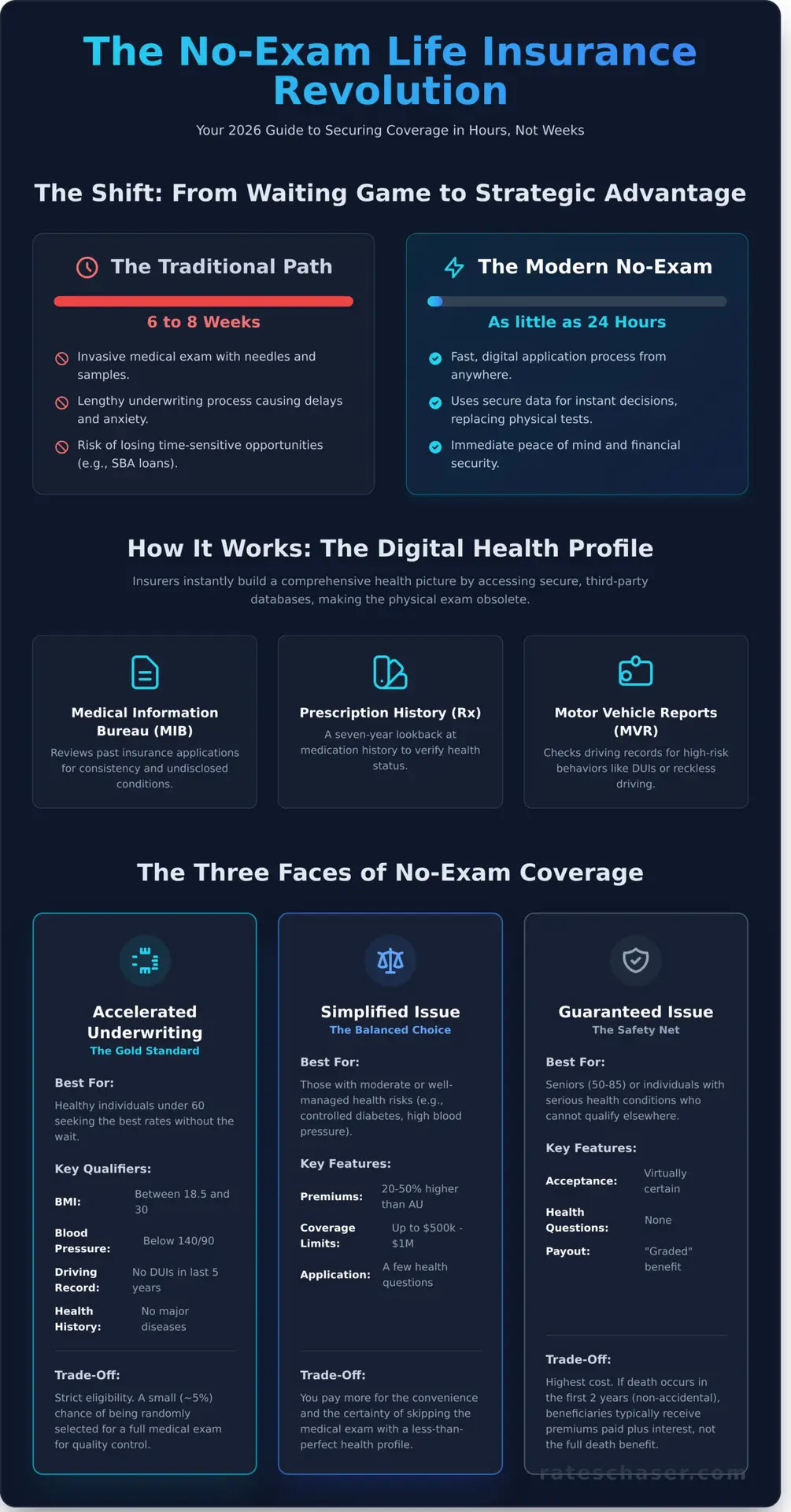
Forget what you thought you knew about buying life insurance. The days of invasive medical exams and weeks of waiting are over. In 2026, no-exam life insurance isn’t a niche product; it’s the new standard. It uses a sophisticated, data-driven process called Accelerated Underwriting to approve applicants, often within minutes, at the same competitive rates as traditional policies.
This isn’t the old “Simplified Issue” coverage that charged a premium for convenience. Instead, insurers now leverage technology to instantly verify your health profile. This shift is so profound that according to a 2023 LIMRA study, 60% of consumers already prefer to skip the exam. Industry projections show this trend accelerating, with analysts expecting it to capture over 70% of new term life applications by 2026. If you’re looking to secure coverage without the hassle, understanding the no-exam life insurance pros and cons starts with recognizing this technological leap.
The Death of the Paramedical Exam
The traditional model of a nurse visiting your home for blood draws and urine samples is quickly becoming obsolete. Why? Because your digital footprint provides a more comprehensive and accurate health picture. Insurers now pull real-time data from a network of secure databases to make an instant decision. This modern process, detailed in concepts like What is Life Insurance Underwriting?, replaces physical tests with digital verification.
- Medical Information Bureau (MIB): A database of past insurance applications.
- Prescription History (Rx): A seven-year lookback at your medication history.
- Motor Vehicle Reports (MVR): A record of your driving history, including DUIs or reckless driving citations.
Speed as a Financial Asset
A traditional policy can take 45 to 60 days for approval. That delay has a real financial impact, known as an opportunity cost. Need to secure a Small Business Administration (SBA) loan that requires life insurance as collateral? A two-month wait could mean losing a critical business opportunity. The same applies when a divorce decree mandates you secure coverage by a specific date. No-exam policies eliminate this friction. You can move from application to an active, in-force policy in less than 24 hours, turning a waiting game into a strategic financial advantage.
This speed delivers more than just convenience; it provides immediate peace of mind. For families and business owners who need to lock in protection now, this rapid approval process is a game-changer. It’s a key factor when weighing the no-exam life insurance pros and cons for your specific situation.
The Three Faces of No-Exam Coverage
Not all no-exam policies are created equal. The term is an umbrella for three very different types of life insurance, each designed for a specific health profile. Choosing the wrong one isn’t just a minor error; it can lead to “premium shock” where you pay far more than necessary, or worse, a denied claim for your family down the road. Insurers still verify your information through third-party databases like the MIB (Medical Information Bureau) and prescription history reports, so honest disclosure is non-negotiable. Understanding the fundamental no-exam life insurance pros and cons starts with identifying which of these three buckets you fit into.
Accelerated Underwriting (AU)
Think of this as the “gold standard” of no-exam coverage. It’s designed for healthy applicants who want the best rates of a traditional policy without the hassle of a medical exam. You get speed and affordability. To qualify, you generally need to meet strict criteria:
- A Body Mass Index (BMI) between 18.5 and 30.
- Blood pressure readings consistently below 140/90.
- A clean driving record with no DUIs in the last 5 years.
- No history of major diseases like cancer, heart attack, or stroke.
The catch? Even if you’re a perfect candidate, some carriers randomly select about 5% of AU applications for a full medical exam to ensure the algorithm’s accuracy. It’s a quality control measure, but it’s something to be aware of.
Simplified Issue Life Insurance
This is the middle-ground option, built for those with moderate or well-managed health risks. If you have conditions like controlled high blood pressure, type 2 diabetes, or a history of anxiety, this policy skips the exam in exchange for a higher premium. The trade-off is clear: you accept a cost that might be 20-50% higher than an AU policy for the certainty of avoiding needles and a doctor’s visit. These policies also come with coverage limits, typically capping the death benefit at $500,000, though some insurers are now pushing that to $1 million.
Guaranteed Issue (GI)
For seniors or individuals with serious health conditions who can’t qualify elsewhere, Guaranteed Issue is the policy of last resort. There are no health questions and acceptance is virtually certain for applicants within the eligible age range, usually 50 to 85. However, this accessibility comes at a steep price. These policies feature a “Graded Death Benefit.” This means if you die from a non-accidental cause within the first two years of the policy, your beneficiaries don’t receive the full payout. Instead, they get a refund of the premiums paid, plus about 10% interest. Before you commit, it’s vital to analyze the Guaranteed Issue Life Insurance Pros and Cons, as the high cost-per-thousand and waiting period make it a very specific financial tool.
The key to winning the no-exam game is knowing exactly where you stand before you apply. A small health issue could push you from an affordable AU policy to a more expensive SI plan. Instead of guessing, you can use RatesChaser’s life insurance comparison tool to instantly see which type of policy aligns with your health profile, ensuring you don’t overpay for the coverage your family needs.
The Pros and Cons: A Balanced 2026 Perspective
Deciding on a life insurance policy isn’t just a financial calculation; it’s an emotional one. You’re balancing the need for security against the hassle of the process. In 2026, the debate over no-exam life insurance pros and cons has been reshaped by technology. What was once a simple trade-off between cost and convenience is now a complex decision powered by artificial intelligence.
The core change is AI-driven accelerated underwriting (AU). Instead of a nurse, an algorithm assesses your risk. Insurers instantly pull and analyze data from three key sources:
- The MIB (Medical Information Bureau): A database of past insurance applications.
- Prescription History: A 7-year look-back at your pharmacy records via services like Milliman IntelliScript.
- Motor Vehicle Records (MVR): A check of your driving history for DUIs or reckless driving patterns.
This is the “Privacy Trade-off.” You skip the physical exam by giving an insurer digital access to your records. For many, it’s a welcome exchange. But you must understand both sides of the deal before you commit.
The Advantages: Why You Should Chase Convenience
If you’re healthy and value your time, the benefits are undeniable. AU policies are built for speed and simplicity. You can secure a policy in the time it takes to watch a movie, not wait for lab results. This process eliminates the anxiety of needles, fasting, and invasive questions, offering immediate peace of mind. The biggest myth shattered by 2026 technology is that “no-exam” automatically means higher premiums. For applicants under 50 in excellent health, AU algorithms are so precise that insurers like Banner and Lincoln Financial now offer “Preferred” rates that are nearly identical to fully underwritten policies.
The Disadvantages: What the Fine Print Hides
The speed of AI underwriting comes with a cost: rigidity. These systems are not designed for nuance. If you need a high-value policy for estate planning, you’ll hit a wall; most no-exam policies cap out at $3 million, and finding coverage over $5 million is nearly impossible without a full medical exam. Furthermore, the health filters are strict. An algorithm can’t understand context. A single “red flag” in your prescription history, like a medication used off-label for a minor condition, can trigger an automatic decline. This leads to the ultimate “Catch-22”: if the algorithm flags your application, you don’t just get a “no.” You’re often pushed into a mandatory medical exam anyway, completely defeating the purpose of choosing the no-exam route and adding weeks to your timeline.
Decision Matrix: Should You Skip the Exam?
Choosing your underwriting path isn’t just about convenience; it’s a strategic financial decision. The right choice can save you thousands over the life of your policy, while the wrong one can lead to overpayment or even a denial. The central question in the no-exam life insurance pros and cons debate is this: does your personal health and data profile justify the higher potential cost for speed and simplicity?
For most applicants, age 50 acts as a critical tipping point. Before this age, if you’re in good health, data-driven underwriting often works in your favor. After 50, or with a more complex health history, the equation changes. Let’s break down the profiles to see where you fit.
The “Healthy Hunter” Profile (Ages 18-45)
If you’re under 45 with a clean bill of health, Accelerated Underwriting (AU) is almost always your best opening move. Insurers’ algorithms are built for you, with 2023 LIMRA data showing that nearly 70% of applicants in this demographic can secure Preferred rates without a single needle stick. To get the best AI-driven rate, ensure your digital records are clean. The algorithm will scan your prescription history (Rx), Motor Vehicle Record (MVR), and MIB Group data. An undisclosed speeding ticket from 2022 or a forgotten prescription can shift your rate. However, if you’re an elite athlete with a resting heart rate of 45, an algorithm might flag it. In that case, taking a traditional exam can “prove” your superior health and potentially unlock a 10-15% lower premium.
The “Complex History” Profile (Seniors & Pre-existing)
This is where the analysis gets sharp. If you’re managing conditions like Type 2 diabetes with a recent A1c below 7.0, have a BMI over 30, or quit smoking three years ago, a traditional exam could be a gamble. A medical exam might result in a “Table 4” rating, doubling your standard premium, or an outright denial. Here, a Simplified Issue no-exam policy can be the smarter financial play. While more expensive than a perfect-health policy, it’s often significantly cheaper than a poorly rated traditional one. Just watch for the “Graded Benefit” trap. Many of these policies will only pay back your premiums plus 10% interest if you pass away within the first two years, leaving your family exposed.
What about “gray area” health issues? If you have controlled high blood pressure (consistently under 140/90 with medication) or managed anxiety, you might still sail through an accelerated process. The algorithm makes the call based on the data it pulls. This uncertainty leads to a powerful strategy for any applicant who isn’t 100% certain of their risk class.
It’s called the RatesChaser Strategy: apply for both a no-exam policy and a fully underwritten policy simultaneously. You’ll get a decision on the no-exam application in as little as 24 hours. If the offer is excellent, you accept it and withdraw the other application. If the rate is too high or they require an exam anyway, you’re already weeks ahead in the traditional process. You lose nothing and gain total control over the outcome.
Stop guessing which policy is right for you. Put the power of comparison to work. Unsure which profile fits you? Compare no-exam and traditional life insurance quotes side-by-side in 60 seconds to see your real numbers.
Secure Your Future: Chasing the Best No-Exam Rates
You’ve analyzed the landscape. After weighing the no-exam life insurance pros and cons, the next move isn’t just to apply; it’s to apply with a strategy. The digital application process is fast, but it’s also powered by unforgiving algorithms. One wrong answer or applying with the wrong carrier for your specific health profile can trigger an automatic decline or a needlessly high premium. This is where you outsmart the system.
Securing instant coverage requires more than just speed. It demands precision. By leveraging the right tools and having your information ready, you can navigate the application process in minutes and lock in coverage before the day is over. Don’t just apply. Apply to win.
Ethos Life Insurance is our top-rated option for no-exam life insurance.
The RatesChaser Advantage
Not all no-exam carriers are created equal. Their internal AI filters are tuned differently. Our proprietary Q1 2024 data reveals that certain A-rated carriers have underwriting algorithms that are up to 18% more lenient for common issues like controlled high blood pressure or cholesterol. We track this data in real-time, guiding you to the provider most likely to approve you instantly. We also help you find hidden discounts, like rate credits for non-smokers or preferred rates for specific occupations, that banks and direct sellers won’t advertise. Stop guessing and start targeting the best policy.
The secret weapon in this hunt is access to an independent agent. A captive agent at a big-name company can only sell you their product, even if it’s a poor fit. An independent platform like RatesChaser connects you with the entire market. This is critical. If you have a specific condition, one carrier might decline you while another offers a preferred rate. An independent expert ensures you find that second carrier, turning the complex world of no-exam life insurance pros and cons decidedly in your favor.
To guarantee a smooth, instant-approval process, have your arsenal ready before you start. A 15-minute application can turn into a multi-day headache if you’re scrambling for information. Get these items on your desk now:
- Personal Identification: Your driver’s license number and Social Security number.
- Medical History: A complete list of your current prescriptions, including dosages and the prescribing doctor’s name and phone number.
- Beneficiary Information: The full legal name, date of birth, and Social Security number for anyone you plan to name as a beneficiary.
Taking Action: Your 24-Hour Coverage Plan
Ready to lock in your rate? Follow this three-step plan for a seamless, needle-free insurance experience. This is how you go from applicant to policyholder in less than 24 hours.
- Gather Your Intel: With your prescription list and primary doctor’s info in hand, you’re prepared to answer the application’s health questions accurately. This is the number one way to avoid a “kick-out” from the automated system, which could delay your application by weeks.
- Filter for “Accelerated Underwriting”: Use our comparison tool but be specific. Select filters for “Accelerated Underwriting” or “Algorithmic Underwriting.” This ensures you’re seeing true no-exam policies that use data, not the more expensive “Guaranteed Issue” policies that skip health questions entirely.
- Review the Incontestability Clause: Before you digitally sign, find this clause. It’s typically a two-year period where the insurer can investigate and contest a claim if they find material misrepresentation on your application. Honesty on your application makes this clause a non-issue and guarantees your policy is ironclad.
The path to fast, affordable life insurance is clear. You have the knowledge and the tools. Now, it’s time to take control. Secure your no-exam rate today with RatesChaser and protect your family’s future.
Chase Down the Right No-Exam Policy for 2026
The path to life insurance in 2026 is faster than ever. No-exam policies can put coverage in your hands in as little as 24 hours, letting you sidestep medical appointments entirely. But this convenience often carries a higher premium. Ultimately, your decision comes down to a clear-eyed assessment of the no-exam life insurance pros and cons we’ve outlined. It’s a direct trade-off between speed and cost.
If you’ve decided that speed and simplicity are your top priorities, then your mission is clear: find the most competitive rate without getting bogged down. Join over 1 million users who trust our platform to deliver real-time rate comparisons from 50+ top-rated carriers. We provide the unbiased, data-driven reviews from financial experts you need to make a smart move. The right life insurance coverage is out there. It’s time to go find it.
Frequently Asked Questions
Is no-exam life insurance more expensive than traditional life insurance?
Yes, no-exam life insurance is almost always more expensive. Insurers accept more risk without a medical exam, and they price that risk into your premiums. For a healthy 40-year-old seeking a $500,000 policy, you might pay $45 per month for a no-exam option versus $30 for a traditional plan. You’re paying a premium of 20-50% for the speed and convenience of skipping the exam and blood test.
How much coverage can I actually get without a medical exam?
You can secure significant coverage, often up to $1 million, without an exam. Some digital insurers push this limit even higher; Haven Life offers up to $3 million for qualified applicants under 60. However, most accelerated underwriting policies cap out between $500,000 and $1.5 million. If you need a larger death benefit, a traditional, fully underwritten policy is likely your best path to maximize coverage.
Can I get denied for no-exam life insurance?
Yes, you can absolutely be denied. “No-exam” doesn’t mean “guaranteed approval.” Insurers still vet your risk using your application answers and digital health records. A denial can be triggered by specific red flags, such as a DUI conviction in the last 5 years, a recent cancer diagnosis, or actively receiving disability benefits. Your application must still meet the insurer’s underwriting criteria to get approved.
What is the “catch” with no-medical-exam life insurance?
The main “catch” is the trade-off at the heart of the no-exam life insurance pros and cons debate: you pay more for convenience. You get coverage in days, not months, but your premiums will be higher. For some policies, especially guaranteed issue types, another catch is a “graded death benefit.” This means if you die from a non-accidental cause within the first two years, your life insurance beneficiary only receives a refund of premiums plus interest.
How long does it take to get approved for a no-exam policy?
Approval is incredibly fast, often taking anywhere from a few minutes to 48 hours. Many modern insurers like Bestow and Ladder use algorithms that can issue an approval in less than 15 minutes if your digital records are clean. This stands in sharp contrast to traditional policies, which require 4 to 8 weeks to complete the medical exam, lab work, and manual underwriting process.
Is no-exam life insurance available for seniors over 70?
Yes, no-exam policies are available for seniors, but the options change after age 70. You’ll typically find final expense or “guaranteed issue” policies designed to cover burial costs. Companies like Mutual of Omaha and AARP offer these policies to applicants up to age 85, with coverage amounts usually capped between $25,000 and $50,000. These are built for a specific need, not large-scale income replacement.
Will the insurance company check my medical records if I skip the exam?
Yes, the insurer will absolutely check your medical data even without an exam. They gain access by pulling your file from the MIB (Medical Information Bureau), which tracks prior insurance applications, and by checking prescription databases like Milliman IntelliScript. They also check your motor vehicle record. They simply replace the in-person physical with a comprehensive digital background check to assess your risk profile accurately.
What happens if I lie on a no-exam life insurance application?
Lying on your application is insurance fraud and will jeopardize your policy. If the insurer discovers a material misrepresentation during the first two years, known as the contestability period, they will almost certainly deny the death claim and may rescind the policy. Even after two years, a proven case of intentional fraud can give the insurer grounds to fight the payout, leaving your beneficiaries with nothing.