

Permanent life insurance is one of the most oversold and misunderstood financial products in America. For decades, agents have pushed ‘cash value’ as a can’t-miss investment vehicle, but is it really the best home for your money in 2026? It’s completely understandable why you’re asking, is life insurance a good investment for my family? You’re trying to protect the people you love while also building wealth, and the conflicting advice can feel paralyzing. The fear of locking your money into a low-return product for 30 years is real, especially when your family’s financial survival is on the line.
This guide cuts through the noise. We will give you a clear, numbers-driven framework to decide if a permanent policy’s tax advantages outweigh its costs or if you’re better off following the classic “buy term and invest the difference” strategy. We’ll break down the real-world returns of cash value policies, compare them directly against a diversified investment portfolio, and show you how to secure the highest possible death benefit for the lowest premium.
Key Takeaways
- Understand the critical distinction between life insurance for pure protection (Term) and policies designed for wealth accumulation (Permanent) to align your strategy with your goals.
- Discover if the classic ‘Buy Term and Invest the Difference’ strategy still holds up in 2026’s financial landscape or if cash value policies offer a competitive advantage.
- Analyze how life insurance stacks up against your 401(k) and stock portfolio in terms of tax benefits and risk to answer if is life insurance a good investment for my family.
- Identify your specific financial profile through clear scenarios to see precisely how a policy can be leveraged for your unique situation, whether you’re a young family or a high earner.
Defining Life Insurance: Protection vs. Investment for Your Family
Let’s cut through the noise. You’re asking, “is life insurance a good investment for my family?” and the answer isn’t a simple yes or no. It depends entirely on how you define ‘investment’ and what you expect the policy to achieve. The industry often blurs the line between pure protection and wealth accumulation, leaving families confused. We’re here to draw that line in the sand.
At its core, all life insurance is designed to manage risk. It’s a contract that provides a tax-free lump sum, known as the Death Benefit, to your life insurance beneficiaries upon your death. But modern policies split into two distinct paths:
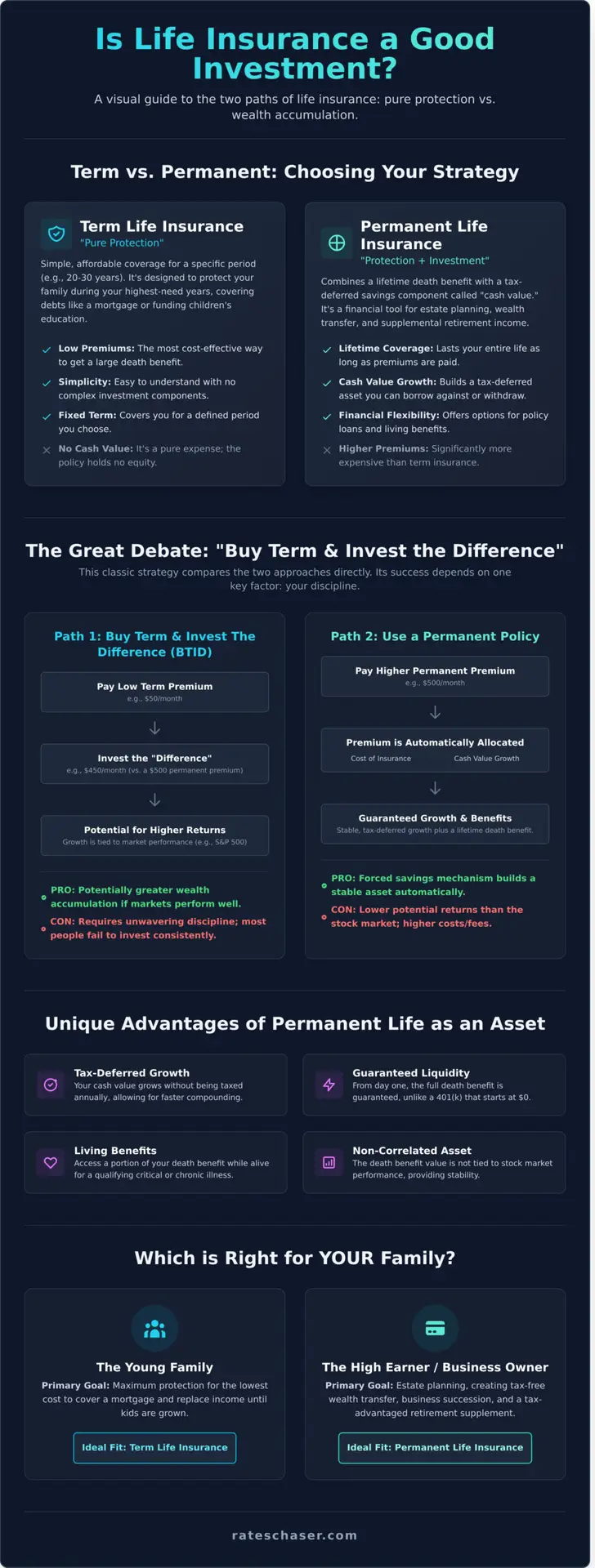
- Term Life Insurance: This is pure protection. You pay a premium for a specific term, like 20 or 30 years. If you pass away during that time, your family gets the payout. It’s straightforward, affordable, and designed to cover temporary needs like a mortgage or raising children. There is no cash value or investment component.
- Permanent Life Insurance: This is protection plus a wealth-building tool. Policies like Whole Life or Universal Life last your entire lifetime and include a savings element that grows over time. It’s more complex and has higher premiums, but it’s designed to be a permanent financial asset.
In the economic climate of 2026, with market volatility fresh in everyone’s minds after the corrections of 2024, families are hunting for stability. The death benefit from a life insurance policy is a non-correlated asset. This means its value isn’t tied to the S&P 500’s performance. When markets fall, your policy’s death benefit doesn’t. This stability is a powerful draw for anyone looking to build a secure financial foundation.
Think about this critical factor: guaranteed liquidity. If you open a 401(k) with a goal of saving $1 million, you have exactly $0 on day one. If you secure a $1 million life insurance policy and pay the first premium, your family is guaranteed that full $1 million from day one. It is the only financial tool that can deliver 100% of its intended goal the moment it’s activated.
What makes something an ‘investment’ in 2026?
An investment today is about more than just aggressive growth; it’s about strategic risk mitigation. While stocks aim for high returns with inherent risk, permanent life insurance balances modest growth with unparalleled security. It’s also a psychological investment. Knowing your family is protected provides a level of peace of mind that no stock certificate can offer. Within these policies, cash value is a tax-deferred savings component within a permanent life insurance policy that grows over time and can be borrowed against or withdrawn.
The dual nature of modern life insurance policies
Permanent life insurance works on two fronts. First, the death benefit creates an instant, tax-free estate for your heirs, often bypassing the lengthy and public probate process. Second, many policies now include ‘Living Benefits’. These life insurance riders allow you to access a portion of your death benefit while you’re still alive if you suffer a qualifying critical, chronic, or terminal illness. This transforms your policy from a death-only tool into a comprehensive financial safety net. This is why it’s a mistake to confuse ‘cost’ with ‘investment’ when evaluating premiums. A term policy premium is a pure cost for protection. A permanent policy premium is part cost, part contribution to a growing financial asset you control.
The Great Debate: Term vs. Cash Value Life Insurance
The question, “is life insurance a good investment for my family,” almost always boils down to one core conflict: term versus permanent. For decades, financial experts have championed a strategy called ‘Buy Term and Invest the Difference’ (BTID). The logic is simple: buy affordable term insurance for pure protection and invest the savings in the stock market for higher returns. In theory, it’s a winning formula.
But does it still hold up in 2026? The strategy’s success hinges entirely on one factor: your discipline. If you diligently invest the difference every single month without fail, you’ll likely come out ahead. The reality is that life gets in the way. Without the structure of a mandatory bill, many families find that “difference” gets spent elsewhere. This is where permanent, or cash value, life insurance enters the conversation, offering a completely different approach.
At its core, permanent insurance bundles a death benefit with a savings or investment component known as ‘cash value’. This value grows over time, tax-deferred. The two most common types are:
- Whole Life: Offers a guaranteed death benefit, level premiums, and a fixed rate of cash value growth. It’s predictable and stable.
- Universal Life: Provides more flexibility. You can often adjust your premiums and death benefit, and the cash value growth is tied to market interest rates, offering potentially higher (but not guaranteed) returns.
The trade-off for this built-in savings is cost. Permanent policies have significant internal fees, including sales commissions that can claim over 50% of your first year’s premium, ongoing mortality charges, and administrative expenses. These costs create a drag on your cash value growth, especially in the early years.
This is the ‘forced savings’ argument in action. For families who struggle to save consistently, the higher premium of a permanent policy acts as a commitment device. It’s a bill that must be paid, ensuring a pool of capital is built over time, regardless of market volatility or competing financial priorities.
Term Life: The High-Leverage Protection Tool
Think of term insurance as the purest form of financial protection. You pay a small premium for a large death benefit over a set period, typically 10, 20, or 30 years. There’s no cash value, no investment component, just a straightforward promise. The return on investment (ROI) is staggering if the policy is needed. A healthy 35-year-old might pay $50 per month for a $1 million, 30-year term policy. Total cost: $18,000. Payout: $1,000,000. It’s unmatched leverage for securing your family’s future. The price gap is massive; you can compare life insurance quotes in minutes to see just how much more coverage you can secure with term for the same dollar.
Permanent Insurance: When ‘Cash Value’ Becomes a Family Asset
For high-net-worth individuals or disciplined savers, permanent insurance can function as a unique asset class. Whole life policies, with their guaranteed returns, can act like a bond alternative in a diversified portfolio. As the cash value grows, it becomes a liquid asset you can access via loans. This is the foundation of the ‘Infinite Banking’ concept, where you essentially become your own lender, borrowing against your policy’s cash value for major purchases. An in-depth NIH analysis of life insurance as an investment confirms its role as a complex financial tool with distinct tax advantages. But be patient; due to high upfront costs, most policies don’t reach their ‘break-even’ point, where the cash value equals the premiums paid, for 10 to 15 years.
Comparing Life Insurance to Traditional Investments (401k, Stocks, Real Estate)
You can’t fairly compare a hammer to a screwdriver. They are different tools designed for different jobs. The same logic applies when you place a life insurance policy next to your 401k, stock portfolio, or real estate holdings. One is designed for protection and tax-free wealth transfer, while the others are built for pure market growth. A smart financial plan doesn’t choose one over the other; it strategically uses both.
The core difference boils down to three key areas: tax treatment, risk exposure, and liquidity. Your 401k offers tax-deferred growth, meaning you pay income tax on every dollar you withdraw in retirement. In sharp contrast, a life insurance death benefit, thanks to IRC Section 7702, is paid to your beneficiaries 100% income-tax-free. This single distinction makes it a uniquely powerful tool for creating generational wealth.
Life Insurance vs. The Stock Market
Let’s be direct: you should never use life insurance to replace your 401k or IRA contributions. These are your primary vehicles for retirement growth. Over the last 30 years (1993-2023), the S&P 500 delivered an average annual return of 10.15%, while a typical Whole Life policy’s cash value might grow at a guaranteed rate closer to 3% to 4%. For pure investment growth, the market wins. However, permanent life insurance offers a critical feature the market can’t: protection from loss. An Indexed Universal Life (IUL) policy, for instance, often includes a 0% floor. If the market index your policy is linked to drops 20%, your cash value is protected and simply earns 0% for that period, shielding your principal from volatility.
The Estate Planning Edge
This is where life insurance truly outshines traditional assets. For high-net-worth individuals, it provides an immediate, tax-free solution to complex financial challenges. If your goal is to build a lasting legacy, asking is life insurance a good investment for my family reveals its strategic power.
- Paying Estate Taxes: With the 2024 federal estate tax exemption at $13.61 million per person, estates above this threshold face a tax of up to 40%. A life insurance policy can provide the instant, tax-free cash to pay this bill without forcing your heirs to liquidate assets like a family business or real estate.
- Equalizing an Inheritance: Imagine you want to leave a $1 million family home to one child. How do you make it fair for your other child? A $1 million life insurance policy provides the perfect solution, delivering an equal value in liquid cash and preventing family disputes.
Ultimately, life insurance acts as a “completion fund.” Your 401k and other investments need decades to mature. If your time is cut short, the death benefit instantly completes your financial plan, delivering the capital you intended to build and ensuring your family’s financial security is locked in.
Is it a ‘Good’ Investment for YOUR Family? (4 Scenarios)
The question isn’t just “is life insurance a good investment,” but rather, is life insurance a good investment for my family’s specific situation? The answer is never one-size-fits-all. Your income, debt, and long-term goals dictate the strategy. Let’s hunt for the right answer by breaking down four common scenarios.
Scenario A: The Young Family with High Debt
If you have a mortgage, student loans, and young children, your greatest financial risk is the loss of your income. Here, life insurance isn’t an “investment” in the traditional sense; it’s a critical safety net. A 30-year-old in good health can often secure a $1 million, 30-year term policy for just $50-$70 per month. This pure protection ensures your family can stay in their home and your kids can go to college if the worst happens. Don’t fall for a complex, expensive policy when your core need is maximum coverage for the lowest cost.
Scenario B: The High-Earner Seeking Tax Advantages
You’ve already maxed out your 401(k) ($23,000 in 2024) and your Roth IRA ($7,000 in 2024). Where do you put your “overflow” savings? A properly structured permanent life insurance policy can act as a powerful supplement. The cash value grows tax-deferred, and you can access it later in life via tax-free policy loans. It becomes less about the death benefit and more about creating another tax-advantaged retirement bucket.
Scenario C: The Business Owner
For business partners, a “buy-sell” agreement funded by life insurance is non-negotiable. If one partner dies, the company’s life insurance policy on that partner pays out. The surviving partner uses that tax-free cash to buy the deceased partner’s shares from their family. This prevents a forced sale of the business and ensures a smooth, immediate transition of ownership without taking on crippling debt.
Scenario D: The Grandparent Transferring Wealth
With the federal estate tax exemption set to be cut nearly in half from $13.61 million after December 31, 2025, efficient wealth transfer is crucial. A life insurance death benefit is paid directly to your named beneficiaries, is almost always income-tax-free, and completely bypasses the costly and public probate court process. It’s one of the cleanest ways to pass wealth to the next generation.
The ‘Buy Term and Invest the Difference’ Math
This popular strategy sounds simple: buy cheap term insurance and invest the premium savings. But the math is tough. If a term policy is $50/month and a permanent policy is $500, you must invest that $450 difference with ironclad discipline. To beat a permanent policy’s guaranteed growth and tax-free access, you’d need to earn a consistent 6-8% after-tax return for decades. With capital gains taxes potentially rising after 2025, that hurdle gets even higher. The #1 failure point isn’t the math; it’s human behavior.
When Life Insurance is a BAD Investment
Answering is life insurance a good investment for my family also means knowing when to walk away. Steer clear if you see these red flags:
- High-Pressure Sales: An agent pushing an expensive permanent policy before they’ve even analyzed your budget or basic protection needs is likely chasing a commission, not securing your family’s future.
- Surrender Charges: Cashing out a permanent policy in the first 5-10 years can be a disaster. Surrender charges can wipe out 100% of your cash value in the early years.
- Lack of Commitment: Don’t buy permanent insurance if you can’t commit to funding it for at least 20 years. Its benefits are back-loaded; it’s a marathon, not a sprint.
The right strategy always starts with the right price for your specific need. If you’re protecting a young family, your first step is clear.
Conclusion: How to Secure the Best Value for Your Family
Your family’s financial plan is a structure built for security. Think of investments like stocks and real estate as the upper floors, designed for growth. Life insurance isn’t one of those floors; it’s the bedrock foundation. Its job isn’t to generate high-yield returns, but to ensure the entire structure stands firm, even when the unexpected happens. The question isn’t just is life insurance a good investment for my family, but rather, how do you acquire this foundational protection without compromising the growth of your other assets?
The answer is simple: you hunt for value with precision. You don’t walk into the first dealership and buy a car at sticker price. You don’t accept the first mortgage offer you receive. Why would you treat your family’s most critical safety net any differently? Securing the best policy requires an unbiased, data-driven approach that puts you in control, not the insurance agent.
Don’t overpay for peace of mind
The ‘Savvy Hunter’ never settles. Instead of taking a single quote from one carrier, you must compare the top-tier providers against each other. A policy from a carrier like Mutual of Omaha might offer better terms for your age group, while Prudential could have a competitive edge for your health profile. Without a side-by-side comparison, you’re flying blind. Your best weapon in this hunt is real-time data. Premiums change, and an offer that was competitive six months ago may be overpriced today.
Your 2026 Action Plan
Executing a smart strategy is about following a clear plan. Don’t get overwhelmed. If you want to lock in the absolute best value for your family this year, your mission involves three critical steps. This is your roadmap to maximizing your family’s financial security while minimizing the cost.
- Determine your ‘Human Life Value’. This is the financial gap your income currently fills. A simple calculation is your annual salary multiplied by the number of years until your planned retirement. For a 40-year-old earning $100,000 and planning to retire at 65, that’s a $2.5 million gap ($100k x 25 years). This number is your starting point for life insurance coverage.
- Choose your vehicle. For over 90% of families, Term Life insurance is the most efficient vehicle. It provides maximum protection for the lowest cost during your highest-earning years. Permanent policies like Whole Life have a place, but typically for high-net-worth estate planning, not for the average family’s protection needs.
- Hunt for the rate. Once you know your coverage amount and policy type, it’s time to find the carrier that offers the lowest premium for your specific profile. This is where you leverage comparison tools to force carriers to compete for your business, ensuring every dollar you spend on premiums delivers maximum protective value.
Before you sign any policy, arm yourself with the right questions. Your advisor works for you. It’s their job to provide total transparency. Here is a final checklist to run through before you commit:
- What are the total commissions and fees built into this policy? Demand a clear, dollar-figure breakdown.
- Can you show me a direct comparison with at least two other A-rated carriers? This verifies you’re seeing the market, not just one company’s offerings.
- What are the exact terms of the “grace period” if I miss a payment? Know the buffer you have before a policy lapses.
- Are there any specific exclusions or limitations I need to be aware of? Ask about dangerous hobbies, travel restrictions, or cause-of-death clauses.
- How long is the “free look” period, and what is the process to cancel if I change my mind? You should have at least 10-30 days by law to review and cancel for a full refund.
Ultimately, a life insurance policy is an exceptional investment in your family’s stability when purchased correctly. It’s a contract that guarantees their financial continuity. By becoming a savvy hunter, comparing the market, and asking the tough questions, you ensure that this foundational investment provides the highest possible return: absolute peace of mind at the lowest possible cost.
Secure Your Family’s 2026 Financial Strategy
The debate is over. Life insurance’s greatest strength isn’t competing with your 401k; it’s delivering unmatched financial protection for the people you value most. As our scenarios showed, the right policy, whether it’s cost-effective term life or a hybrid cash value plan, is a deeply personal decision. The answer to is life insurance a good investment for my family isn’t found in a simple yes or no. It’s found by analyzing your specific needs against the market’s best options. That’s where you gain the advantage.
Don’t navigate the complex carrier landscape alone. Since 2020, RatesChaser has delivered unbiased financial advocacy, empowering families to make smarter choices. Our platform gives you access to real-time, data-driven comparisons and expert reviews of top-tier carriers, ensuring you don’t overpay for peace of mind.
Frequently Asked Questions
Is life insurance better than a high-yield savings account for my family?
No, they serve fundamentally different purposes and aren’t direct competitors. A high-yield savings account, currently earning around 4.25% APY, is for liquid, short-term savings and emergency funds. Life insurance is a long-term risk management tool designed to provide a tax-free death benefit to protect your dependents. While some policies build cash value, their primary function is protection, not high-yield growth. If you need accessible cash, an HYSA is the superior choice.
Can I lose money in a life insurance ‘investment’?
Yes, it’s possible to lose money, particularly with variable or universal life policies. The cash value in these policies is often linked to market performance, so if underlying investments decline, your cash value can decrease. Furthermore, if you surrender a policy within the first 10-15 years, the surrender charges can be significant, potentially causing you to receive less money than you paid in premiums. Always review a policy’s fee structure before you commit.
What are the tax benefits of life insurance for my heirs in 2026?
The single most powerful tax benefit is that the death benefit is paid to your beneficiaries 100% income-tax-free. Under current tax law, this rule remains firmly in place. With the 2026 federal estate tax exemption projected to be around $7 million per individual, most estates won’t owe estate taxes either. This makes life insurance an incredibly efficient way to transfer wealth, ensuring your heirs receive the full policy amount without a surprise bill from the IRS.
Is whole life insurance worth it if I already maximize my 401k?
It can be, but only for specific high-net-worth individuals seeking tax diversification and estate planning. If you’re already contributing the maximum to your 401(k) ($23,000 in 2024), whole life offers tax-deferred cash value growth. For most people wondering if life insurance is a good investment for my family, the high premiums of whole life make term insurance and investing the difference a more efficient strategy for building wealth.
How much life insurance does a typical family actually need?
A widely accepted guideline is to secure coverage equal to 10 to 12 times your current annual income. For a family with a household income of $100,000, this means a policy between $1 million and $1.2 million. This amount is designed to replace your lost income and cover major financial obligations like a mortgage, outstanding debts, and future college tuition. Use an online calculator to fine-tune this number based on your specific debts and assets.
Can I cash out my life insurance policy if I need money for an emergency?
Yes, but only if you have a permanent policy like whole or universal life that has accumulated cash value. You can typically access funds by taking a loan against the cash value or making a withdrawal. Loans are often tax-free but reduce your death benefit if not repaid. Term life insurance, which accounts for over 70% of policies sold in the U.S., has no cash value component and cannot be cashed out for emergencies.
What happens if I can’t afford the premiums on my ‘investment’ policy later?
You have several options before letting the policy lapse. You can use the policy’s accumulated cash value to pay the premiums for a set period, which is a common feature. Alternatively, you can request a “reduced paid-up” option, which stops future payments but maintains a smaller, permanent death benefit. Your final option is to surrender the policy entirely to receive its cash value, though this may trigger fees and taxes.
Is ‘buy term and invest the difference’ still the best advice?
For over 90% of American families asking if life insurance is a good investment for my family, yes, this remains the most effective and transparent strategy. It separates your insurance needs from your investment goals. You secure affordable protection with term life, then invest the savings in low-cost index funds. The premium difference between term and whole life can easily be $300+ per month, which can grow to a substantial nest egg over 20-30 years.