

Here’s a fact the insurance industry won’t advertise: most new parents overpay for life insurance by at least 25%. You’re navigating the beautiful chaos of a new baby, where every dollar in your budget suddenly has a new job. The pressure to protect your child’s future is immense, but so is the confusion from endless policy options and conflicting advice. If you feel like you’re just guessing between ‘Term’ and ‘Whole Life’ while trying to keep monthly costs down, you’re not alone.
This is your strategic guide to stop guessing and start winning. We’re giving you the blueprint to secure maximum financial protection for your family at the absolute minimum cost. By the end of this article, you’ll have a clear coverage number, understand exactly which policy type fits your 20-year plan, and know how to find affordable life insurance for new parents that provides true peace of mind.
Key Takeaways
- Discover why your employer’s plan is likely insufficient and learn to calculate your true ‘Family Protection Number’ using the DIME method.
- Determine whether a cost-effective Term Life policy or a Permanent plan with cash value is the right strategic fit for your family’s financial goals.
- Unlock significant savings on life insurance for new parents by mastering advanced tactics like policy laddering and strategic application timing.
- Learn how to chase down the best rates from top carriers to ensure you get maximum coverage for your family without overpaying.
Why New Parents Need a Life Insurance Strategy in 2026
Bringing a child into the world instantly redefines your financial priorities. Suddenly, your focus shifts from personal goals to providing a lifetime of security for someone else. This is where a smart strategy for life insurance for new parents becomes non-negotiable. At its core, a policy is a simple contract. A comprehensive answer to what is life insurance is that it’s a financial promise: in exchange for premium payments, an insurer guarantees a tax-free lump sum to your beneficiaries if you pass away. This isn’t about wealth; it’s about ensuring continuity for your child’s future.
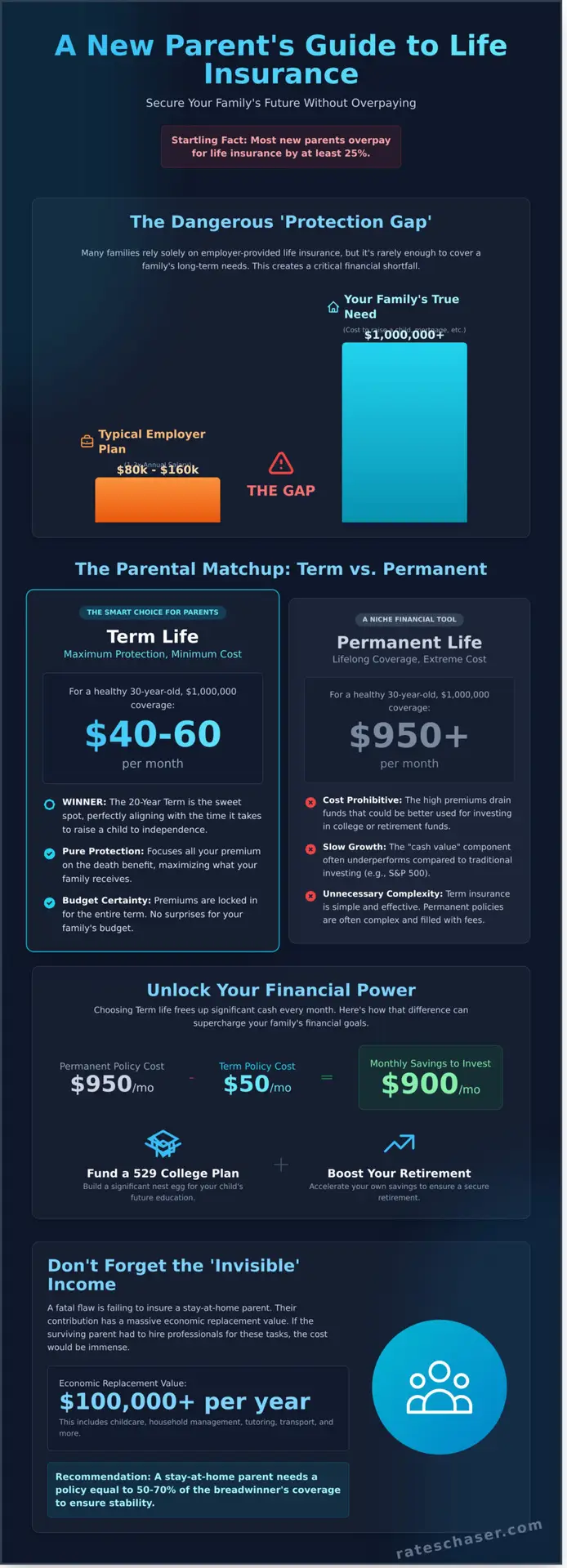
Many new parents mistakenly believe their employer-sponsored plan is enough. This creates a dangerous ‘Protection Gap’. A typical group policy only offers coverage equal to 1-2 times your annual salary. If you earn $80,000, that provides a $160,000 payout. That sounds like a lot, but it won’t last long when faced with decades of expenses. It’s a temporary patch, not a long-term solution designed to replace your income and protect your family’s quality of life.
The True Cost of Raising a Child Today
The 2026 reality is stark. According to 2022 data from the U.S. Department of Agriculture, raising a child to age 18 costs an average of $310,605. With persistent inflation, that figure is projected to be even higher for a child born today. This isn’t an abstract number; it’s a concrete breakdown of your family’s future budget.
- Housing: Accounts for nearly 30% of the total cost, covering the need for a larger home or apartment.
- Food: Represents another 18% of the total expense over 18 years.
- Childcare: For families with two young children, the average annual cost of center-based care now exceeds $24,000 in 20 states, often rivaling a mortgage payment.
Final expenses like a burial account for just 1% of this financial need. Your coverage must be built to replace income, pay off the mortgage, and fund education. Speaking of which, that $310,000 figure doesn’t even include the cost of college, which sees tuition rates inflating by up to 5% annually.
The ‘Invisible’ Risk: Stay-at-Home Parents
A fatal flaw in many family financial plans is failing to insure a non-earning parent. Their contribution isn’t measured in salary, but its economic impact is massive. If you had to pay for the services a stay-at-home parent provides, the annual cost could easily exceed $100,000 when you factor in childcare, transport, tutoring, and household management. Economic Replacement Value is the total cost to hire professionals to perform all the unpaid tasks a stay-at-home parent handles. This is why a non-earning parent needs a policy equal to at least 50-70% of the breadwinner’s coverage. The policy isn’t replacing an income; it’s providing the funds the surviving parent needs to pay for critical support services so they can continue working.
Ultimately, a robust life insurance for new parents strategy delivers the ultimate dividend: peace of mind. It transforms the abstract anxiety of “what if?” into a concrete plan of action. Securing this protection allows you to focus on the joy of parenthood, confident that you’ve built a financial fortress around the people who matter most.
Term vs. Permanent Life Insurance: The Parental Matchup
Choosing a life insurance policy isn’t just about buying a product; it’s a strategic financial decision. For new parents, this decision boils down to a clear matchup: term versus permanent life insurance. One is built for pure, high-impact protection during a specific timeframe. The other is designed for lifelong coverage with an investment component. Let’s break down which one wins the title for your family.
The core difference is simple. Term insurance covers you for a set period, like the 20 years it takes to raise a child. Permanent insurance covers you for your entire life. For the vast majority of young families, one option delivers far more value and aligns perfectly with your immediate needs.
Term Life: Maximum Coverage for Minimum Cost
Think of term life insurance as pure protection. It’s the savvy hunter’s choice because it focuses your dollars on what matters most right now: securing the largest possible death benefit for the lowest cost. You select a term, typically 10, 20, or 30 years, and your premium is locked in for that entire period. No surprises. This provides critical budget certainty when you’re juggling new expenses like diapers and daycare.
The cost difference is staggering. A healthy 30-year-old can often secure a $1 million, 20-year term policy for about $40-$60 per month. A permanent whole life policy with the same $1 million death benefit could cost upwards of $950 per month. By choosing term, you free up nearly $900 every month that you can invest directly into your child’s 529 college fund or your own retirement accounts, building wealth far more efficiently.
This is why most financial experts point to the 20-year term as the sweet spot for new parents. It aligns perfectly with your child’s journey to financial independence, ensuring the mortgage is paid, college is funded, and your partner is supported if the unthinkable happens during those critical two decades.
Permanent Life: Wealth Transfer and Lifelong Security
Permanent life insurance, like whole or universal life, is a specialized tool. It combines a lifelong death benefit with a “cash value” savings component that grows on a tax-deferred basis. While often pitched as a forced savings vehicle, the high premiums and internal fees mean it’s rarely the right fit for the average family’s primary protection needs.
So, when does it make sense?
- Estate Planning: For high-net-worth families, the death benefit
Calculating Your ‘Family Protection Number’
Forget the old ’10x salary’ rule. That’s a blunt instrument from a different financial era. In 2026, securing your family’s future demands precision, not a ballpark guess. Your goal is to calculate a specific ‘Family Protection Number’ that acts as a financial fortress for your loved ones. This number ensures their lifestyle continues, their goals are met, and their future is stable, even if you’re not there.
The industry gold standard for this calculation is the DIME Method. It’s a simple yet powerful framework that moves beyond salary multiples to cover the four pillars of your family’s financial life. It’s the most effective starting point when shopping for life insurance for new parents because it accounts for real-world obligations.
The DIME Method Breakdown
Think of this as your family’s financial blueprint. Add these four figures together to find your baseline coverage amount.
- Debt: Total all non-mortgage debts. This includes everything from your $30,000 in student loans and $25,000 car loan to that $8,000 credit card balance. The goal is a clean slate for your family.
- Income: How many years of your income would your family need to replace? A solid target is the number of years until your youngest child turns 18 or 20. If you earn $90,000 annually and have a newborn, you’d multiply that by 20 for a total of $1,800,000.
- Mortgage: This is your ‘Home Security’ component. The policy should be large enough to pay off the remaining mortgage balance in full. A paid-off home eliminates your family’s single largest expense and provides immense stability.
- Education: College costs are rising relentlessly. According to 2024 projections by entities like Vanguard, a four-year public university degree for a child born today could exceed $250,000 by 2042. You must account for this staggering future expense for each child.
After you’ve calculated your DIME total, you can make strategic adjustments. For instance, you can subtract existing assets like savings or current life insurance policies. You should also factor in Social Security Survivor Benefits. A surviving spouse caring for a child under 16 can receive up to 75% of the deceased worker’s benefit, a ‘hidden’ offset that could reduce your total need by thousands per year. Finally, have a realistic conversation about your spouse’s income. Would they need to hire more childcare to maintain their career, or would they choose to reduce their hours? Adjust your income replacement goal accordingly.
The Role of ‘Living Benefits’ and Riders
Modern life insurance for new parents is more than just a death benefit. Smart policies include riders that add a layer of protection while you are still living. These options transform your policy from a simple safety net into a versatile financial tool.
- Accelerated Death Benefit: If you’re diagnosed with a terminal illness (typically with a life expectancy under 12-24 months), this rider allows you to access a significant portion of your death benefit while you are still alive to cover medical bills or other expenses.
- Waiver of Premium: What if you become totally disabled and can’t work or pay your bills? This rider ensures your life insurance policy doesn’t lapse by waiving the premium payments during your period of disability. It’s insurance for your insurance.
- Child Term Riders: For a few extra dollars a month, you can add a small term life policy (e.g., $10,000 or $20,000) for your children. This can cover final expenses and often guarantees their future insurability, allowing them to convert it to a permanent policy later, regardless of their health.
The Savvy Parent’s Playbook: Laddering and Timing
Securing the best rate on life insurance isn’t just about your health; it’s about strategy. Smart timing and structuring your coverage can unlock thousands in savings over the life of your policies. Don’t just buy a policy. Build a financial shield designed for your family’s specific journey.
For expecting parents, the clock starts ticking early. The ‘Goldilocks’ zone for applying is often around 20 weeks of pregnancy. At this point, you’re past the first-trimester uncertainties, but typically before the significant weight gain or potential gestational hypertension of the third trimester. Underwriters are accustomed to seeing pregnancy-related changes and can often look at your pre-pregnancy baseline health to assign a rating.
Your goal is to lock in a ‘Preferred Plus’ rating. To do this, treat the medical exam like a final exam. For the 24 hours prior, avoid caffeine, alcohol, and strenuous exercise. Fast for at least 8 hours before the blood draw and schedule your appointment for the morning when blood pressure is naturally lower. These simple steps can directly impact your premium by 15-25%.
How to Build an Insurance Ladder
Why pay for coverage you no longer need? A single, massive 30-year policy is inefficient. Instead, you can layer multiple, smaller term policies with different end dates. This strategy, known as laddering, matches your coverage to your declining debts over time, saving you an average of 20-30%.
- Step 1: The Foundation. Buy a 30-year term policy to cover your largest, longest-term debt: the mortgage. If you have a $500,000 mortgage, this is your base layer.
- Step 2: The Child-Rearing Years. Layer a 20-year term policy on top. This covers the expensive period until your child is independent, including college savings. A $300,000 policy might be appropriate here.
- Step 3: The Peak-Expense Decade. Add a final, 10-year term policy. This provides maximum protection during the years of daycare, initial school costs, and lost income if one parent stays home. This could be a $200,000 policy.
In this example, you have $1 million in coverage for the first 10 years. After that, the 10-year policy expires, and your premium drops. After 20 years, the next policy expires, and your premium drops again, leaving you with just the mortgage coverage for the final decade.
Navigating Pregnancy and Underwriting
If you apply later in pregnancy or postpartum and receive a higher rate, don’t panic. Many insurers have a 6-month postpartum rule. If your weight and blood pressure return to pre-pregnancy levels within 6-12 months of delivery, you can request a reconsideration for a better rate. The most critical rule: never cancel an existing policy until your new, approved policy is officially “in force.” A gap in coverage is a risk your family can’t afford.
Finally, always be ready to review your ‘chaser’ stats. Life insurance isn’t a “set it and forget it” product. If you make a significant lifestyle change, it’s time to hunt for a new rate. Quitting smoking for just 12 months can slash your premiums by up to 50%. Losing 20 pounds or improving your cholesterol can also trigger major savings. This is exactly the kind of strategic thinking that defines an effective plan for life insurance for new parents. Ready to see how much you could save with a smarter strategy? Compare customized quotes from top insurers.
Chase the Best Rates for Your Growing Family
You’ve done the hard work of determining your family’s needs. Now it’s time to hunt for the policy that protects them without draining your budget. Sticking with a single provider out of convenience is a trap. Insurers count on it, and this misplaced loyalty can cost you dearly. Our 2025 Q4 market analysis revealed that new parents who failed to compare at least three carriers paid an average of 22% more for identical term life coverage. You wouldn’t overpay for diapers or a crib; don’t make that mistake with your family’s financial safety net.
The only way to guarantee you get the most competitive premium is to shop the market. This is where you shift from defense to offense. By comparing top-tier carriers like Mutual of Omaha, Prudential, and Banner Life side-by-side, you expose the pricing gaps and find the true market value for your coverage. It’s not about finding the cheapest policy. It’s about securing the best value for your specific health profile and financial goals.
Why RatesChaser is Your Best Ally
We’ve engineered a smarter way to secure life insurance for new parents. Our platform leverages millions of real-time data points to forecast 2026 rate trends, giving you an edge. You see transparent, unbiased quotes instantly without a high-pressure sales pitch. More importantly, we help you filter for carriers offering robust ‘Living Benefit’ riders, which allow you to access a portion of your death benefit early if diagnosed with a qualifying chronic, critical, or terminal illness-a critical safety layer for any parent.
So, what does the journey from application to approval look like in 2026? Technology has dramatically streamlined the process. For healthy applicants under 50, you can expect:
- Digital Application: Completed in under 15 minutes.
- Accelerated Underwriting: Algorithms review your data, often providing a decision in 24 to 72 hours, no medical exam required.
- Policy Delivery: Your digital policy is issued and active within 3 to 5 business days from your initial application.
Once your policy is approved, a few final housekeeping steps will solidify your family’s protection. Use this checklist to ensure every detail is locked in.
- Designate Your Primary Beneficiary: This is typically your spouse or partner who will receive the policy payout directly.
- Name a Contingent Beneficiary: This is your backup. It could be a trusted family member or, ideally, a trust set up for your children’s benefit. Never name a minor directly, as it can create legal complications.
- Secure Your Digital Policy: Save the official policy documents in a password-protected digital vault or cloud folder (like Google Drive or Dropbox). Share the location and access credentials with your spouse and the executor of your will.
Next Steps: Secure Your Legacy Today
You are moments away from locking in peace of mind. The hunt for the best rate starts with our 5-minute comparison tool. Use this opportunity to also organize your financial ‘Black Box’-a single, secure digital folder containing your life insurance policy, will, and other key documents. This simple step ensures your spouse or your child’s guardian can manage everything without added stress during a difficult time. Don’t wait. Your family’s future is too important.
Secure your family’s future-compare life insurance rates now.
Secure Your Family’s 2026 Financial Future Today
Navigating parenthood is complex, but your financial strategy doesn’t have to be. You now have the tools to calculate your precise ‘Family Protection Number’ and understand the critical difference between term and permanent policies. Securing the right life insurance for new parents isn’t just a purchase; it’s a strategic move, especially when using advanced tactics like policy laddering to maximize coverage while minimizing costs.
The theory is clear. Now it’s time for action. If you’re ready to find the most competitive policy for your family, then it’s time to leverage a smarter tool. Our platform gives you instant access to real-time data from over 50 top carriers, delivering unbiased comparisons tailored for new parents and backed by expert-reviewed 2026 financial insights.
Start your hunt for the best family life insurance rates today. You’ve done the research; take the final, decisive step to lock in their protection. Your peace of mind is just a few clicks away.
Frequently Asked Questions
Is it better to get life insurance before or after the baby is born?
It’s better to secure life insurance before your baby is born. Applying while you’re younger and healthier typically locks in lower premium rates for the entire term of the policy. Pregnancy can sometimes introduce temporary health conditions, like gestational diabetes, which could increase your rate by 5% to 10% or delay an application’s approval. If you want to maximize your savings and guarantee coverage, apply before or during the early stages of pregnancy.
Can stay-at-home parents get life insurance if they have no income?
Yes, stay-at-home parents can and absolutely should get life insurance. Their labor provides immense economic value that would be costly to replace. Think about childcare, household management, and transportation costs. A 2022 Salary.com analysis valued a stay-at-home parent’s contribution at over $184,000 annually. A policy ensures your surviving partner has the funds to cover these essential services without financial strain, protecting your family’s stability.
How much life insurance does a new father or mother need?
A strong starting point is to get coverage equal to 10 to 12 times your gross annual income. For a parent earning $80,000 per year, this means a policy between $800,000 and $960,000. This amount should be enough to cover long-term expenses like paying off the mortgage, funding 18 years of childcare, and saving for college tuition. It’s a simple formula to ensure your child’s financial needs are met until they become independent adults.
Does life insurance cover pregnancy complications?
No, a standard life insurance policy does not cover medical costs from pregnancy complications. Life insurance is designed to pay a death benefit to your beneficiaries; it isn’t health insurance. For coverage related to medical treatments for conditions like preeclampsia or an emergency C-section, you must rely on your health insurance plan. Your life insurance policy only pays out in the event of your death, regardless of the cause.
Can I name my minor child as the primary beneficiary?
You can’t name a minor child as a direct beneficiary on a life insurance policy. Insurers are legally barred from paying large sums directly to a minor. The correct strategy is to create a trust and name that trust as the beneficiary. You then appoint a trusted adult as the trustee to manage the funds for your child’s benefit until they reach the age of majority, which is 18 or 21 in most states.
Is term life insurance cheaper than whole life for young parents?
Yes, term life insurance is significantly more affordable and practical for most young parents. A healthy 30-year-old can often secure a $500,000, 20-year term policy for just $25 to $40 per month. A whole life policy with the same death benefit could cost over $400 monthly. Term life provides pure protection during the years your children are most financially dependent, making it a highly efficient way to secure their future.
What happens to my life insurance if I lose my job?
If you own a personal life insurance policy, it is completely independent of your employment. Your coverage remains active as long as you continue making your premium payments on time. However, if your only life insurance is a group plan provided by your employer, you will typically lose that coverage when you leave the company. This is a key reason why owning a private policy offers new parents superior financial security.
Should I buy life insurance for my newborn baby?
No, buying a separate life insurance policy for your newborn is not a financial priority. The primary purpose of life insurance is to replace lost income, which doesn’t apply to a child. Your money is better spent on maximizing your own coverage. The best financial protection you can offer your child is a robust life insurance for new parents policy on yourself and your partner. This ensures they will be provided for no matter what.
